The global AI market is on track to reach nearly a trillion dollars by 2030. And yet, most organizations sit at a score of 260 out of 500 on AI maturity — past the experiment phase, but nowhere near scaled. That's the core finding of the Synozur 2026 AI Report, and it's also the subject of the latest episode of Polaris Pulse.
This episode covers three areas: the size and growth of the global AI market, where organizations actually stand on the maturity curve, and three predictions for the year ahead. Here's a look at what the data shows.
Breaking: Microsoft Reorganizes Copilot
The morning this episode recorded, Microsoft announced a significant restructuring of its Copilot organization — unifying consumer and commercial AI under four pillars: Copilot experience, Copilot platform, Microsoft 365 apps, and AI models. Jacob Andreou has been named EVP of Copilot, reporting directly to CEO Satya Nadella. Nadella described the move as the shift "from a collection of great products to a truly integrated system." It's a signal that the model layer is becoming foundational — which connects directly to one of our 2026 predictions.
How Big Is the Market?
AI market projections for 2026 range from $244 billion to over $2 trillion, depending on how broadly you define the market — whether you count hardware, devices, or just software and services. At Synozur, we reviewed projections from Gartner, IDC, Precedence Research, Fortune Business Insights, and Grand View Research, then applied our own weighted averaging methodology.
Our projection: $453 billion in 2026, growing to $944 billion by 2030. North America holds approximately 36% of global AI spend, with the U.S. alone projected at $201 billion this year. The Asia-Pacific region is growing fastest and could surpass North America's share by the early 2030s.
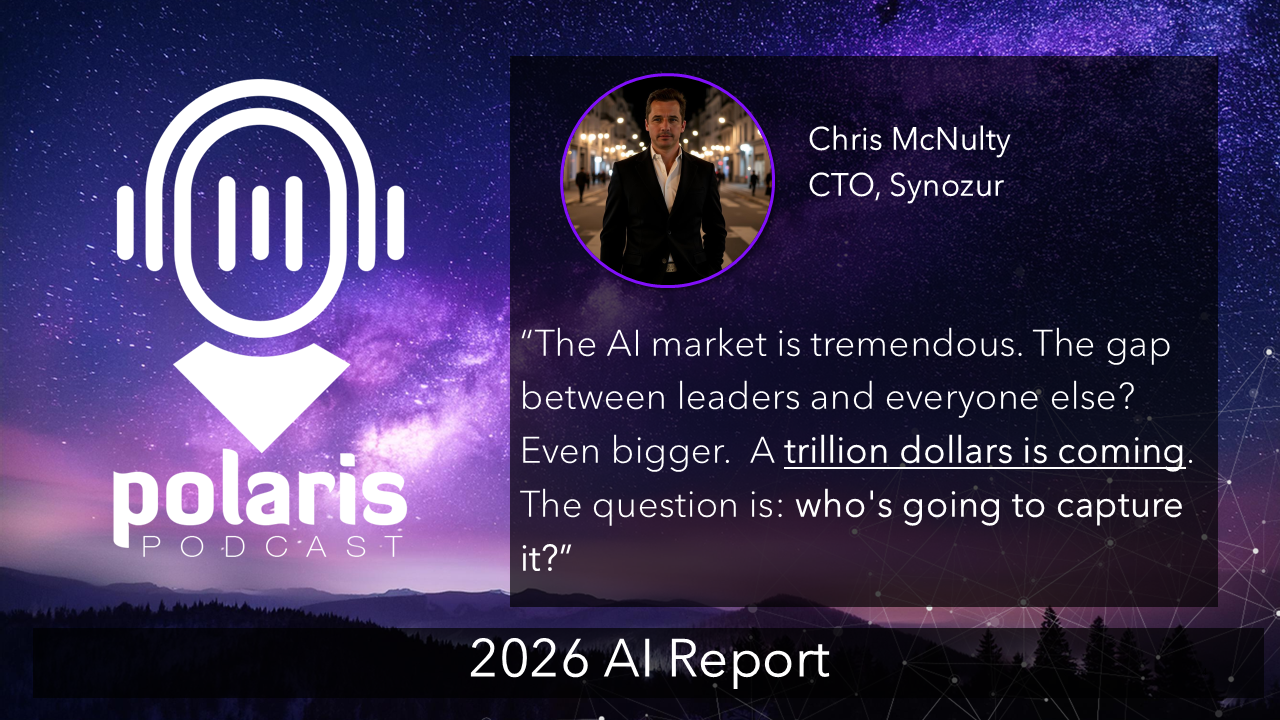
The trillion-dollar question isn't whether this market will keep growing. It will. The question is: which organizations will capture meaningful value from it?
Where Do Organizations Actually Stand?
Synozur CEO Michelle Caldwell spent much of 2025 building our AI Maturity Model — a CMMI-based 100–500 point framework developed by synthesizing research from 17 leading advisory firms. Since publishing it on Orion, our free digital assessment platform, more than 125 organizations have worked through the model.
The average score: 260 out of 500. That puts most organizations in the "Developing" tier — moving past early experimentation, but not yet running AI at scale. The spread is where it gets interesting: scores range from 100 to 500, a gap of more than 250 points between the leaders and everyone else.
Who's ahead? Professional services firms and small organizations (10–49 employees), averaging 300–330. They're agile, knowledge-centric, and quick to move. Who's struggling? Mid-market firms (50–999 employees), scoring 171–225 on average — the "squeezed middle" that has the resources to experiment but not yet the infrastructure to scale. Physical industries like agriculture and manufacturing trail at 168–200.
The weakest dimensions across the board: use-case integration and culture and change management — the exact capabilities you need to move AI from a successful pilot into everyday operations. This isn't a technology problem. It's a people and process problem.
That finding is consistent with Deloitte's 2026 State of AI in the Enterprise, released at Davos in January: only 25% of companies have moved 40% or more of their AI pilots into production. And per new research from the Quantum Institute, the cost of that gap is rising fast — AI-mature organizations now achieve operating margins 47% higher than their early-stage peers, up from 21% just 18 months ago.
Three Predictions for 2026
In October 2025, in partnership with our friends at ClearPeople, Synozur sat down to formalize our 2026 predictions. Here's what we're calling:
1. Microsoft ships its own first-party LLM. Model choice is becoming a competitive differentiator. Microsoft has already integrated Claude from Anthropic into Copilot and Copilot Studio alongside GPT-5 from OpenAI. We predict Microsoft will introduce its own business-tuned LLM by June 2026 — likely announced at Microsoft Build in May. Different models for different jobs is the future. One-size-fits-all is the past.
2. The "Agent Boss" platform arrives. Managing multiple AI agents today means cutting and pasting between Copilot, ChatGPT, Perplexity, Replit, NotebookLM, and more. A new class of applications — built on A2A (Agent-to-Agent) protocols — will give business users a unified dashboard to coordinate, assign, and measure agent performance without IT involvement. At least one major collaboration platform (Microsoft or Google) makes a significant move here in 2026.
3. Professional associations fill the regulatory gap. AI regulation in the U.S. remains fragmented. We predict legal, accounting, and healthcare associations lead with their own credentialing frameworks and standards — setting the blueprint for government regulation in 2027 and beyond.
Get the Full Report
You can download the Synozur 2026 AI Report at aka.synozur.com/AI26 and take the free AI Maturity Assessment at aka.synozur.com/aimm to benchmark your own organization.
Listen to the full episode of Polaris on Apple, Spotify, Amazon, YouTube or wherever you get your favorite podcasts. Thanks.
Show Notes
Takeaways
The AI market is enormous — and the range of estimates tells you everything. Global AI spend in 2026 is projected anywhere from $244 billion to $2 trillion, depending on what you count. Synozur's weighted average: $453 billion this year, growing to $944 billion by 2030.
Most organizations are stuck in the middle. Across 125+ companies assessed using Synozur's AI Maturity Model, the average score is 260 out of 500 — beyond experimentation, but far from scaled. The gap between leaders and laggards spans more than 250 points.
Small firms and professional services are winning. Agile, knowledge-centric organizations score in the 300–330 range. Mid-market companies (50–999 employees) trail at 171–225 — a "squeezed middle" that represents the biggest opportunity for intervention.
Culture and use-case integration are the weakest links. These are the two dimensions most critical to scaling AI beyond a pilot — and they consistently score the lowest across every region and sector assessed.
The pilot-to-production gap is real and costly. Per Deloitte's 2026 State of AI in the Enterprise (released at Davos), only 25% of companies have moved 40% or more of their AI pilots into production. AI maturity isn't a technology problem — it's a culture and execution problem.
Three predictions for 2026: Microsoft launches its own first-party LLM by June; a new "Agent Boss" platform category emerges to help business users manage multiple AI agents in one place; and professional associations — not governments — set the first meaningful AI standards in the U.S.
AI maturity is now a financial differentiator. Research from the Quantum Institute analyzed 847 publicly traded companies and found AI-mature organizations now achieve operating margins 47% higher than early-stage peers — up from 21% just 18 months ago.
Sound Bites:
"The AI market is tremendous. The gap between leaders and everyone else? Even bigger."
"A trillion dollars is coming. The question is: who's going to capture it?"
"On average, organizations score 260 out of 500. They've moved beyond experimentation — but they're nowhere near scaled. The spread is the real story."
"If 2025 was about experimentation, 2026 will be about consolidation and governance. Knowledge is power."
"Most agent management today is cut and paste. If you're jumping between Copilot, ChatGPT, Perplexity, Replit, and NotebookLM — that's a messy process. Something has to change."
"Professional associations need to fill the regulatory gap. We expect legal, accounting, and healthcare associations to lead well before Washington does."
References
Research & Reports
Deloitte AI Institute, State of AI in the Enterprise 2026: The Untapped Edge — released at Davos, January 21, 2026. Key finding: only 25% of companies have moved 40% or more of AI pilots into production; 34% report using AI to "deeply transform" their business. Read the report
McKinsey & Company, The State of AI in 2025: Agents, Innovation, and Transformation — finds nearly 88% of organizations use AI, but most remain in early scaling stages. Read the report
The Quantum Institute, The AI Maturity Gap: Why Enterprise Transformation Is Accelerating in 2026 — analysis of 847 publicly traded companies shows AI-mature organizations achieve operating margins 47% higher than peers; revenue growth 2.3x faster. Published March 17, 2026. Read the research
Synozur, 2026 AI Report: The Market Is Big, the Gap Is Bigger — the full report referenced in this episode. Synozur Insights blog - download your copy at https://aka.synozur.com/AI26
Companies & Platforms Referenced
ClearPeople — Synozur submitted AI market predictions to ClearPeople CEO Katya Linossi, a recurring Polaris collaborator, for the 2025 Knowledge & AI Market predictions project.
Orion by Synozur — AI-powered digital maturity assessment platform; hosts the free AI Maturity Model. Take the free assessment at https://aka.synozur.com/aimm
Frameworks & Protocols
MCP (Model Control Protocol) — A unified protocol for connecting content and data sources to AI agents, cited as a 2025 Synozur prediction that came true.
A2A (Agent-to-Agent Protocol) — A protocol enabling AI agents to communicate with each other; foundation for the predicted "OmniAgent" platform category.
CMMI Framework — Capability Maturity Model Integration; the structural basis for Synozur's 100–500 point AI Maturity Model.
Events
M365 Community Conference | April 21-23 at the Loews Sapphire Falls in Orlando Florida
AI+IM Summit | April 28-30 Hyatt Regency Inner Harbor, Baltimore, MD
TechCon 365 Chicago | June 15-19 McCormack Place I Chicago IL
Production
Polaris is produced with help from Riverside.fm. Our theme song, “Alternative Dream” is provided courtesy of Adobe. Additional music and sound provided by IndieGuy Records. Graphic design by Josh Brantley.
Chapters
00:00 The State of AI in 2026
02:19 News and Data Points
04:21 2026 AI Market
05:27 AI Maturity Research
07:11 2026 AI Predictions
12:14 Events
13:23 Next On Polaris
14:00 Closing