In the first volume of this series, I looked at a newer and broader definition of marketing that plays a vital role in shaping and delivering product innovation to customers with a balanced approach between listening to the market and speaking to the market.
In case you missed it:
Marketing connects markets to products and brings products to markets
Marketing has primary responsibility for developing and delivering the brand and the products to all key channels and stakeholders, and is the decision-maker on naming, messaging, and long-term offering strategy.
Traditional definitions of marketing are often post-product – that is, they assume the marketing is “given” a completed product to take to a market. But as I noted earlier, marketing also has a crucial role in pre-product activity. If you “own” your market, you’re in a great positioning to listen to what it tells you about unmet needs.
While composing the first volume, I reflected on varying terms that describe these processes - inbound marketing, and outbound marketing. As you’ll see, both are very post-product, and cover the information outflows and inflows for product messages.
We're going to look at the classical definitions of inbound and outbound marketing. Then, I’ll propose an expanded set of terms that include pre-product and stakeholder actions to paint a more complete picture about marketing directions.
Marketing Directions
Marketing isn’t just about promoting a finished product; it’s increasingly about listening to your market before you build, and even enabling your internal teams to carry the message. In today’s fast-paced environment (think AI revolutions and changing buyer behavior), modern marketers combine inbound and outbound tactics and even create new ones to drive product strategy and business growth.
Let’s break down the traditional definitions of inbound vs. outbound marketing, see how the lines are blurring, and introduce new directions (sometimes jokingly called “upbound” and “downbound”) that broaden what marketing means for you and your organization. Along the way, I’ll tie in some current trends – from the rise of AI to the power of personalization – and highlight real examples. By the end, you’ll see how these pieces fit together into a comprehensive strategy, and how you can apply these insights (with a handy link to our services for when you’re ready for help). Let’s dive in!
Classical Inbound vs. Outbound Marketing
To start, let’s ensure we’re on the same page with classical definitions of inbound and outbound marketing:
Inbound Marketing is all about pulling customers in toward your company with valuable content and experiences tailored to them. Instead of pushing ads at people who may not want them, you attract them by being helpful, interesting, and relevant. Inbound is grounded in building trust and relationships over time.
Key Characteristics: You attract visitors by offering valuable content (like insightful blog posts, videos, or tools) that addresses their needs. You engage them by providing solutions and conversations that align with their pain points and goals – so they want to learn more or eventually buy. And you delight them with support and useful follow-up, turning customers into promoters of your brand.
Typical Inbound Tactics: Content marketing is king here. Think blogs, e-books, infographics, how-to guides, whitepapers and research reports – any content that draws interest. SEO (Search Engine Optimization) is crucial, so that your great content gets found on Google. Social media engagement is another pillar – sharing helpful posts or user-generated content to start conversations with your audience. You might host webinars or launch a podcast that educates listeners (for example, Synozur’s Polaris podcast offered insights on AI trends). All these tools put useful information out there in places where your target customers are already looking, thereby naturally attracting them.
Example: Imagine you sell travel gear. A classic inbound move is publishing a blog post like “10 Must-Have Items for Solo Travel.” Travelers find it via Google or social media, enjoy the tips, and notice your product subtly recommended in the mix. They feel helped rather than sold to – and that positive experience brings them closer to becoming customers.
Outbound Marketing is the traditional approach of pushing your message out to where customers are, whether they asked for it or not. It’s more proactive in grabbing attention: you reach out directly to tell people about your product or service.
Key Characteristics: Outbound is often interruptive – think ads that play before a YouTube video or a cold sales email in your inbox. The idea is to cast a wide net or directly target prospects and hope your message sticks. Outbound efforts are initiated by the marketer, not the consumer.
Typical Outbound Tactics: Classic examples include television and radio commercials, print ads in magazines or billboards, cold calling potential clients, mass email campaigns, and direct mail like postcards and brochures. These days, outbound also spans paid online advertising (search ads, display banners) and targeted social media ads. Events and trade shows can be outbound too – you sponsor a booth or conference talk to get in front of attendees. Even a well-placed cold email or LinkedIn message to a prospect is outbound marketing in action.
Examples: If inbound marketing evokes helpful blog posts, outbound brings to mind Don Draper-era ad campaigns. For instance, big TV spots like those $8 million Super Bowl ads are outbound extravaganzas – broad, flashy, aiming to leave an impression on millions. On a smaller scale, your company might run an email blast announcing a new product to thousands of contacts (whether or not they’ve heard of you). Synozur did this with their TechCon 365 Dallas event promotion, using blog posts, email invites, and paid social posts to drum up 250 leads for the conference. Another example: sending printed invites or swag to select prospects to promote an upcoming webinar (yes, snail mail marketing still exists and can be quite effective in the digital age!).
In summary, inbound = “come see us (because we have what you need)”, and outbound = “hear us out (we think you’ll want what we offer)”. Inbound nurtures pull-based interest through valuable content, whereas outbound pushes out broad messages to find interested buyers. Both aim to generate demand – they just go about it differently, as we’ll explore.
The Difference in Approach and Why It’s Blurring
You might be wondering, which approach is better? The truth is, modern marketing uses both, because they serve different purposes. Inbound and outbound differ in how they approach the audience, but they increasingly work hand-in-hand. Here’s a quick comparison of their approaches and metrics:
💡 Inbound Marketing | 💥 Outbound Marketing |
Focuses on earning attention by being helpful and relevant. Customers come to you when they’re ready. | Focuses on grabbing attention by being proactive and persistent. You go to the customers to get your message out. |
Key techniques: content creation, SEO, social media engagement, thought leadership, opt-in emails. | Key techniques: advertising (TV, print, digital), cold outreach (calls, emails), events, direct mail. |
Measures of success: website traffic, organic leads, conversion rates from content, cost per lead (usually lower), long-term customer loyalty. | Measures of success: impressions/reach, response rate (e.g. email open/click rates), immediate conversion rate, cost per acquisition, return on ad spend. |
Strength: builds trust and brand authority. Inbound leads often feel more authentic and are cheaper to acquire over time. | Strength: yields quick exposure. You can scale messaging to thousands or millions instantly and generate awareness fast. |
Weakness: takes time to build up content and SEO traction; you’re relying on customers to find you. | Weakness: can be seen as intrusive or be tuned out; often costs more (especially paid ads) to get results. |
Despite these differences, the line between inbound and outbound marketing is getting blurrier. In practice, many campaigns blend elements of both. For example, a conference or webinar has both inbound and outbound elements. You promote it with outbound tactics (emails, ads to drive registrations – pushing the message out), but the event content itself is inbound marketing – delivering valuable insights that attract prospects in. When someone attends and learns without a hard sell, that’s inbound; when you sent them a LinkedIn invite or a mailer to convince them to attend, that was outbound. It’s a mix!
In fact, some marketing leaders now use terminology differently. At Microsoft, it’s said that “inbound” can mean any activity where customers come to you – so by their definition, even things like blogs, events, or email campaigns (traditionally called outbound) are lumped under “outbound” because they are outward-facing communications. Confusing, right? The takeaway is that the old definitions don’t always fit real-world marketing, and what you call inbound or outbound may depend on perspective.
What’s important is understanding how to integrate both approaches. The best strategies today use inbound to attract and nurture interest, and outbound to amplify reach and kickstart conversations. In fact, combining the two gives you synergy:
Wider Reach, Deeper Engagement: Outbound can broadcast your brand to a huge audience (think trending hashtag ads or a mass email), while inbound keeps those who respond engaged with quality content.
Better Lead Generation: Inbound tactics like a helpful podcast or a viral infographic can generate leads on their own; pair them with outbound follow-ups (like an email drip campaign to those podcast listeners) and you’ll nurture more qualified leads into sales opportunities.
Brand Trust + Recognition: Outbound builds initial awareness – someone sees your ad or hears about your event. Inbound builds trust – they read your insightful article or industry research and start considering you a thought leader. Together, your brand becomes both visible and credible. Companies that balance both see stronger brand presence.
Efficiency and ROI: Inbound leads often have a lower Customer Acquisition Cost (CAC) because they found you organically. Outbound guarantees exposure but can be pricier. When you nurture inbound leads you attracted for “free” with some outbound retargeting (say, a little spend on LinkedIn ads to folks who downloaded your eBook), you often get more bang for your buck than either approach alone. Studies show integrated, data-driven campaigns (using a connected CRM to combine inbound/outbound data) dramatically improve marketing effectiveness (87% say campaigns are effective when using integrated data, vs only 52% without that coordination).
The bottom line: inbound and outbound aren’t enemies; they’re partners in your marketing mix. Modern marketing is about choosing the right blend for your goals – and also going beyond inbound/outbound in some new ways we’re about to explore.
Evolving Inbound Marketing: From Content to Product Strategy
One of the key evolutions in marketing is using “inbound” principles not just to get customers, but to decide what to build for customers in the first place. This is a new kind of marketing work – let’s call it “Development Marketing” – essentially inbound marketing for product strategy.
Traditionally, marketing was something you did after a product existed. But as I highlighted in Volume 1, marketing today also has a crucial pre-product role. If you truly “own your market,” you should be listening to it and identifying unmet needs before your competitors do. In other words, marketing can drive input into the product development process (inbound information flow), not just output messaging.
Listening to the Market (Inbound for Insights)
Think of all the ways you, as a marketer, gather market insights: customer feedback sessions, surveys, interviews, social media listening, engaging with industry analysts and thought leaders, studying competitor offerings, market research reports, etc. These activities are about bringing outside information inward – essentially an inbound flow of market intelligence. Some companies are starting to label this as a component of marketing (whereas before it might have been purely product management or R&D’s job).
Marketing teams now frequently lead the charge in defining the market landscape – for example, working with firms like Gartner or IDC to size the market and define new categories. Calculating the TAM (Total Addressable Market) for a potential solution is a marketing-led effort in many organizations.
We often conduct a SWOT analysis (Strengths, Weaknesses, Opportunities, Threats) from a market perspective – which helps pinpoint where a new product could fit or how an existing product should evolve. This strategic groundwork is marketing intelligence that guides product strategy.
Sometimes, seemingly disparate trends coalesce into a new market opportunity. The team might notice, “Hey, a lot of customers are asking about AI capabilities, and we see trends in big data, machine learning, automation… perhaps these are parts of a larger solution space we should enter.” A great real-world example is how “generative AI” emerged as a market: Over a few years, the separate threads of big data, cloud computing, machine learning, and even chatbots wove together into a booming new market for generative AI solutions. Marketers paying attention could piece together the elephant from its parts (to borrow the parable) – and size the opportunity. Today, the generative AI market is exploding – Synozur projects it ro reach over $500 billion by 2030. That kind of insight can direct a company’s R&D investments.
In essence, this is inbound marketing in the sense of “incoming” information – you’re marketing to your own organization the idea of what customers need. It’s like flipping inbound on its head: rather than pulling customers to the product, you’re pulling customer voices into the product planning.
From Insights to Offering: Marketing’s Role in Product Development
Once you’ve identified a market need, marketing also helps shape how the product should be packaged, messaged, and brought to market. It’s often said that marketing turns technologies into products and products into businesses. Here’s how that plays out:
Defining the Value Proposition: Marketing, having listened to the market, articulates the solution in terms customers will resonate with. What problems will this product solve? What messaging will hit home for these pain points? This often guides the product features themselves. If prospects keep asking for a simpler way to do X, marketing ensures the product team knows that and that the eventual messaging highlights “we make X easy”.
Pricing and Packaging Strategy: How you price your product (subscription vs. one-time, usage-based vs. user-based) can make or break its success. Marketers bring market context: what are people willing to pay and how do they expect to buy? For example, if all competing tools are priced per user, and customers show resistance to usage-based pricing (maybe it’s too unpredictable for them), marketing might advise to follow the per-user model. There’s an art to setting a price that customers find reasonable and that sustains your business. Marketers gather intel on pricing through customer interviews and studying purchasing patterns. (As a fun aside: if you priced food by the molecule, it’d confuse buyers – better to price by the pound or serving! Similarly, in software, you choose metrics that customers understand and value, not something esoteric like CPU cycles consumed.)
Go-to-Market Planning: Even while the product is being built, marketing is plotting the launch: what channels to promote in, which early adopters to target, what stories to tell. That plan is informed by all the inbound intel gathered. For instance, if your inbound research shows that a certain industry is crying out for a solution, your go-to-market might focus on that vertical with tailored case studies and webinars at launch.
All these activities – from market research to product positioning – were traditionally not labeled “inbound marketing.” But in a broader sense, they are upstream inbound: they rely on pulling information in from the outside world and using it to shape your strategy. This is what we’re calling Development Marketing – marketing’s role in product development. It’s inbound work because it starts with listening, but it’s also creative and strategic work to turn those insights into a viable product concept.
Development Marketing (a proposed new term) encompasses the listening and research activities that inform product innovation – essentially marketing-driven product strategy. It’s “inbound” in that information flows from customers and market into the company, guiding what you build and why. It's a long-term, strategic facet of marketing, distinct from day-to-day product development or coding, but just as crucial to eventual success.
“Enablement Marketing”: Inbound for Internal Stakeholders
Another “new” direction in marketing broadens who your marketing is aimed at. Typically, I think marketing’s audience = customers. But consider this: to make a product successful, especially in B2B, you often need to convince internal teams and partners just as much as external buyers. Enter what I’ll call Enablement Marketing.
Enablement marketing is all the activity a marketing team does to create awareness and understanding among your extended value chain – that means your sales force, customer support reps, reseller partners, distributors, etc.. These folks might not be end-customers, but they are critical to reaching end-customers. If they don’t understand your product or aren’t excited about it, it’ll never reach its potential.
Think of it as marketing inbound to the organization – ensuring your own company and partners “get” the product’s value so they can help sell it. Some examples:
Sales Enablement Materials: Marketing often produces internal playbooks, cheat sheets, and training sessions for the sales team when a new offering launches. This might include competitive battle cards (so sales knows how to position against rivals), product FAQs, and pitch decks tailored to different client needs. While not public-facing, these are marketing materials aimed at effectively “marketing” the product to the sales reps so they can market it to clients.
Internal Comms & Enthusiasm: Have you ever seen an internal email newsletter or a Town Hall demo of an upcoming product? That’s marketing generating buzz internally. If you get your thousands of employees pumped up and talking about the new product, that energy ultimately reaches customers. Microsoft, for instance, has huge internal readiness programs for their armies of sellers whenever a big product (like a new version of Windows or a new Azure service) is nearing release. It’s essentially a campaign targeted at employees.
Partner Marketing: Many companies rely on channel partners or resellers. Marketing might run webinars for partners, create co-marketing brochures, or a partner portal with assets partners can use. All of that is to educate and entice partners to push your product. It’s marketing to your allies instead of direct-to -customers.
Why call this “inbound marketing”? Some people do, oddly enough. The logic might be that it’s inbound in the sense of bringing those stakeholders into your product’s story. But naming aside, the point is marketing isn’t just outward-facing anymore. A lot of effort goes into equipping internal teams and partners – without it, even a great outward campaign can fizzle if, say, your salespeople aren’t able to continue the conversation with an interested lead.
Enablement Marketing (another newish term) is marketing aimed at your internal stakeholders and partners to enable broader success of the product. It ensures everyone in the value chain understands the messaging and value. You can have the best ad campaign of the year (outbound) and the catchiest blog (inbound), but if your own sales reps or resellers can’t clearly articulate the offering, opportunities will be lost. Enablement marketing fills that gap by treating employees/partners as another audience that deserves tailored marketing attention.
The New Marketing Mix: Development, Enablement, and Customer Marketing
We’ve introduced two new facets (Development and Enablement marketing) that go beyond the classical inbound/outbound concept. Let’s put it all together:
Development Marketing – Upstream, strategic marketing that listens to the market and informs what products or features to develop. It’s about shaping the product strategy based on market needs and trends (our “new kind of inbound” for product innovation).
Customer Marketing – The traditional mix of activities aimed at acquiring and engaging customers. This is where classic outbound and inbound tactics live (campaigns, content, ads, events, social media, etc., all directed at prospects and customers). It’s basically the sum of what we typically just call “marketing” – creating demand, nurturing leads, and driving adoption among your target buyers. We’ll dive deeper into these tactics in Volume 3, including emerging methods like account-based marketing (ABM), storytelling approaches, and more.
Enablement Marketing – Downstream, internally-focused marketing that empowers sales, support, and partners to amplify your reach. It ensures your wider team can effectively sell and support the product by “marketing” its value to them in creative ways.
From arrows going every which way – in, out, up, down – we’ve arrived at a new direction for marketing. Indeed, you can imagine:
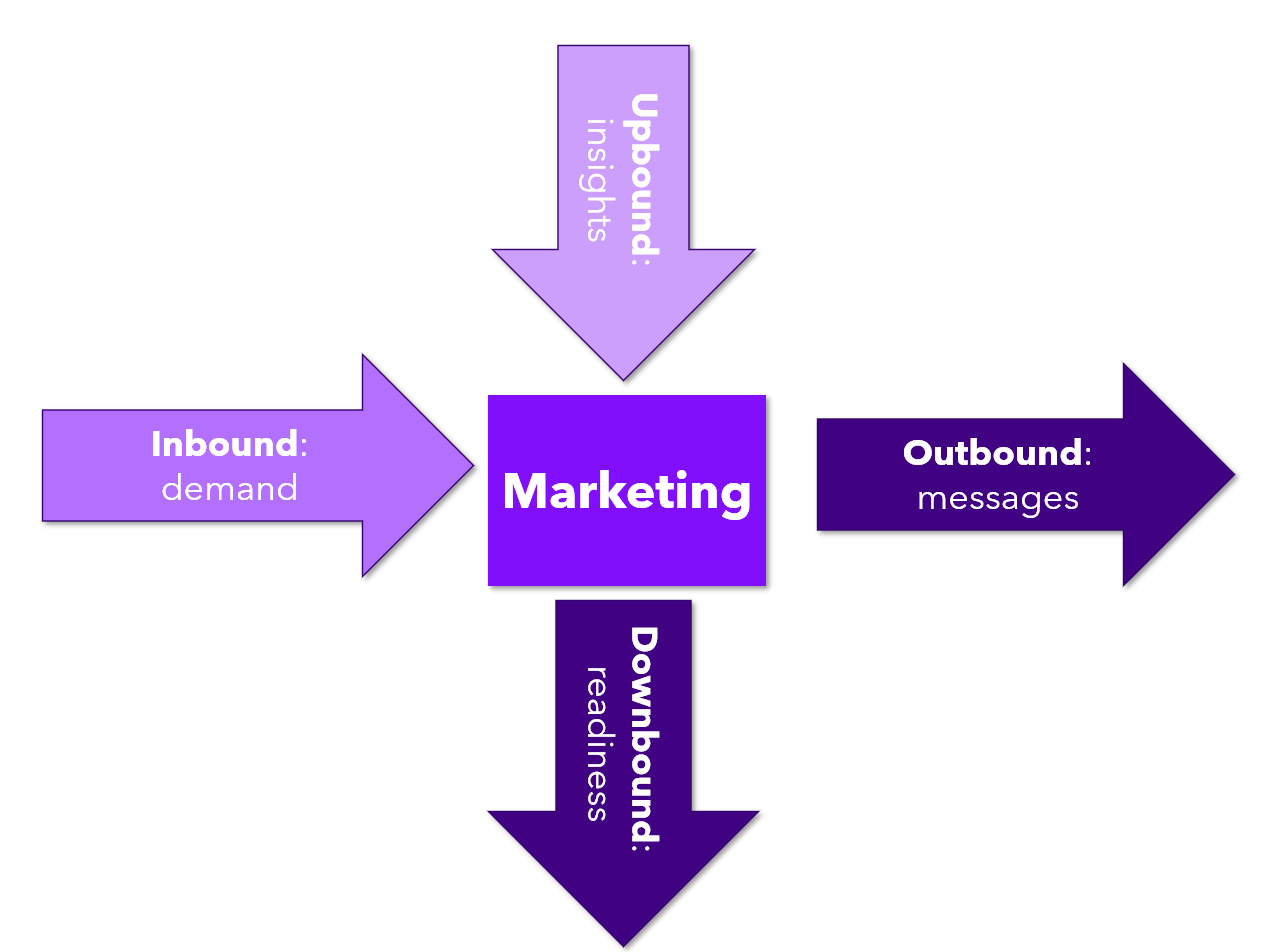
inbound = coming in from customer to company (demand, feedback, interest)
outbound = going out from company to customer (messages),
upbound (or development) = going upstream into product development
downbound (or enablement) = going downstream into the field organization
All these directions need to be aligned under the marketing umbrella.
Why does this matter? Because marketing today is taking an increasingly central role in driving the entire business, not just customer acquisition. To leverage that, we as marketers must broaden and integrate our understanding of these activities. The CMO’s purview is a lot bigger than it used to be. We’re not just running ads or posting on social – we’re influencing product roadmaps, shaping pricing strategy, enabling global sales teams, and yes, still crafting campaigns and content to win customers. It’s a lot, but it’s also what makes modern marketing exciting and integral.
So, if you’re keeping score:
Classic Inbound Marketing – bring in leads with content and relationship-building.
Classic Outbound Marketing – push out campaigns to find leads and build awareness.
Customer (Outbound+Inbound) Marketing – deliver the integrated campaigns and dialogues that connect products with markets
Development (“Upbound”) Marketing – guide product strategy by listening to the market.
Enablement (“Downbound”) Marketing – market the product’s value to internal teams/partners so they can effectively reach customers.
All together, these form a holistic view of marketing’s directions. Next, let’s look at some real-world trends and examples illustrating these concepts in action.
Trends and Examples Shaping Modern Marketing
To ground these ideas, let’s highlight a few current trends and success stories that any modern marketer (like you!) should know:
The Great Attention Shift: Consumers in 2025 are drowning in content. Marketers have realized it’s not just about getting traffic to your site, it’s about holding attention once you get it. HubSpot’s SVP of Marketing put it this way: “Instead of scaling traffic, we need to scale attention.” In practice, that means focusing on quality engagement – time spent, repeat visits, meaningful interactions – not just vanity metrics. It reinforces the importance of inbound content that is truly valuable. If your content doesn’t grab and keep attention, outbound ads to bring people in won’t have lasting effect.
AI as the New Team Member: The rise of AI is transforming marketing both in execution and strategy. 92% of marketers say AI has already impacted their marketing roles in some way – from automating data analysis to generating first drafts of content. Many teams now treat AI tools as just another part of the team for research, copy suggestions, even chatbots for customer service. That said, there’s caution: over half of marketers feel overwhelmed by how to implement AI properly, and only ~47% are confident in measuring AI’s effectiveness. So if you’re experimenting with AI, you’re not alone in figuring it out. Key takeaway: AI can handle the grunt work (data crunching, initial ideas), freeing you to add the human touch. In product strategy (development marketing), for instance, AI might help sift through thousands of customer comments for common pain points, but a human still needs to synthesize that insight into a creative product idea. Use AI as a powerful support, but keep your marketer’s intuition in the driver’s seat.
Visual and Authentic Content Boom: Short-form videos and visual storytelling are dominating both B2C and B2B marketing now. Platforms like TikTok, Instagram, and YouTube are leading channels to engage audiences. At the same time, authenticity is paramount – consumers (especially Millennials and Gen Z) respond to brands that share values and real stories, not just polished ads. That’s why even in B2B, we see more conversational webinars, behind-the-scenes videos, and genuine thought leadership posts on LinkedIn. Your inbound content should educate or entertain, yes, but it also should humanize your brand. Authentic, value-driven content builds trust (that’s your inbound ethos) which makes your later outbound efforts more warmly received.
Power of Personalization: A huge trend is tailoring marketing to individuals. Thanks to better data and AI, you can customize emails, web experiences, even product recommendations at scale. And it works – 96% of marketers report increased sales from personalization efforts. People simply respond better when messages feel hand-picked for them. In practice, this might mean segmenting your content (e.g., sending a different whitepaper to a CFO than to a CTO because their interests differ) or dynamically changing a webpage to show products relevant to the visitor’s industry. Personalization blurs inbound/outbound lines too: automated email follow-ups (outbound) that reference exactly what someone did on your site (inbound behavior) feel more like a helpful nudge than a generic blast.
Memorable Campaigns (Outbound done right): We can’t talk marketing examples without tipping our hat to some iconic campaigns:
Coca-Cola’s “Share a Coke” – Coca-Cola printed people’s names on bottles, turning a classic mass-market product into a personal connection. It sparked millions of social media shares (free inbound buzz following an outbound tactic) as people hunted for their names and shared selfies with Coke bottles. The lesson: outbound doesn’t have to feel impersonal if you invite the audience to participate.
Old Spice’s “The Man Your Man Could Smell Like” – This witty 2010 TV ad campaign (featuring the impossibly suave guy on a horse) went viral online. Old Spice took a traditional outbound channel (TV ads) but made it so entertaining and share-worthy that it generated inbound interest (people voluntarily watched and shared the ads on YouTube). It completely rejuvenated the Old Spice brand. The humor and creativity showed that knowing your audience’s sense of humor is part of listening to the market.
GoPro’s User-Generated Content (UGC) Strategy – GoPro makes cameras, but their marketing masterstroke was showcasing videos shot by their own customers. Every jaw-dropping snowboard jump or surfing clip filmed on a GoPro and shared by users became marketing content for them. This community-driven content served as continuous inbound marketing (awesome videos drawing more folks to check out GoPro) and cost GoPro very little. It’s a great example of delighting customers (part of inbound methodology) and leveraging that to attract new ones.
Red Bull’s Extreme Stunts (Red Bull Stratos) – Red Bull literally sent a man to space (Felix Baumgartner’s jump from the stratosphere) and streamed it, tying their brand to the ultimate thrill. Talk about an outbound event with inbound payoff: millions tuned in out of sheer interest (inbound attraction to unique content), and Red Bull’s brand was at the center. It cemented Red Bull’s image as more than an energy drink – it’s an adventurous lifestyle brand.
These examples might be on a huge scale, but the principles apply to your campaigns too. The best marketing today engages people on their terms (inbound) while still getting your message out far and wide (outbound).
Putting It All Together (And How We Can Help)
We’ve covered a lot – from how inbound marketing evolved beyond blogs into something that can drive your product innovation, to how outbound marketing still plays a critical role in spreading the word, to new concepts like development and enablement marketing that broaden the marketer’s role.
At the end of the day, successful modern marketing is holistic and integrated. You’re orchestrating a symphony where each instrument (inbound content, outbound campaigns, product input, internal enablement) plays its part at the right time. When done right, it doesn’t just drive sales – it builds a brand that customers trust and love, products that truly meet market needs, and an organization that’s aligned to deliver value.
Conclusion
So there you have it, from arrows going every which way in, out, up, down, in circles or zigzags, we’ve arrived at a new direction for marketing.
Thank you for reading this far! I hope you found some useful nuggets to apply in your marketing efforts. In Volume 3, I’ll dive into the characteristics and habits of successful marketers. And in Volume 4 I’ll look at what it takes to become a high-impact marketing leader. Stay tuned for that!
Need help crafting your own modern marketing strategy? You don’t have to navigate these waters alone. At Synozur we specialize in integrating inbound, outbound, and product strategy marketing to drive real business results. Whether you’re looking to better understand your market, launch a new campaign, or enable your sales team with stellar content – we’d love to help. Learn more about our services here and feel free to reach out with any questions.
Until next time, keep listening to your market and creatively connecting with your audience. That’s the heart of modern marketing, and you’ve got this! 👊
References
HubSpot's 2025 Marketing Trends Report: Insights from Over 1,700 Global ...