On our latest episode of Polaris, we recap Microsoft’s latest AI news. If you’re leading a business or technology team, their announcements probably landed with a mix of excitement and unease.
A new top‑tier Microsoft 365 plan.
A brand‑new platform for governing AI agents.
And a reimagined Copilot that behaves more like a teammate than a chatbot.
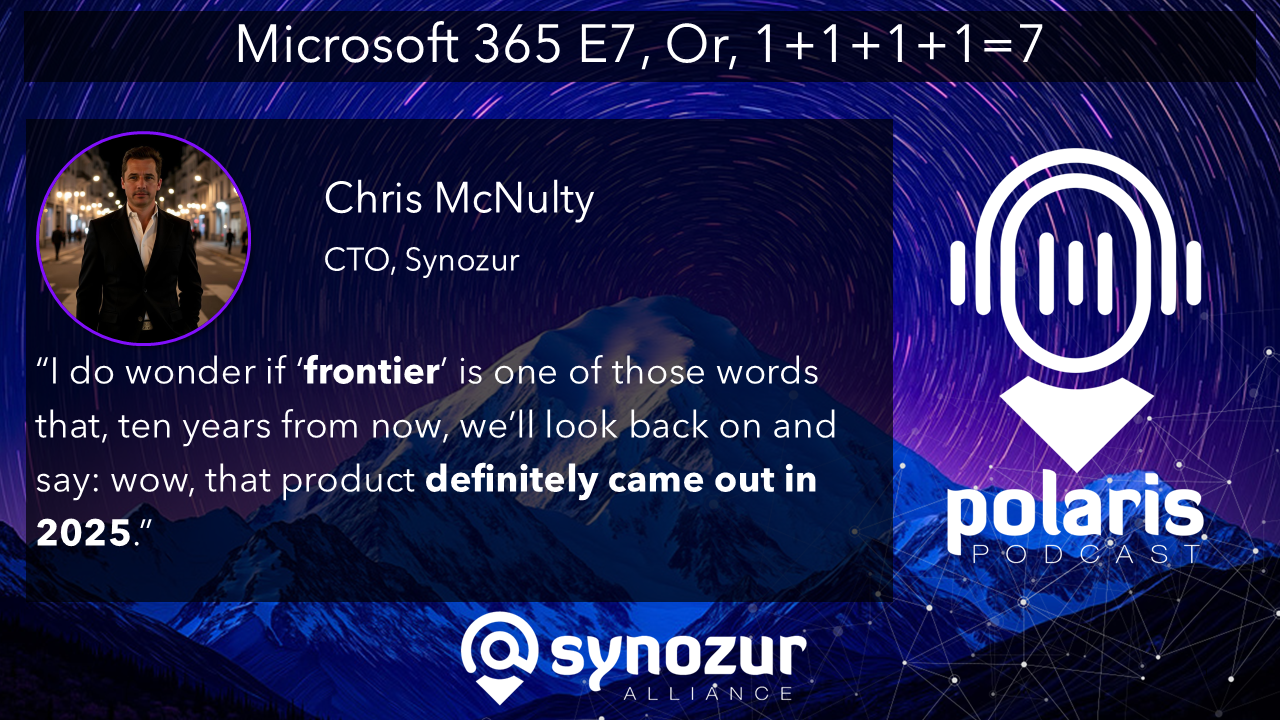
Individually, each announcement is interesting. Taken together, they tell a very clear story about where Microsoft believes enterprise AI is heading—and what organizations will need to operate there safely.
Let’s unpack what Microsoft announced, why it matters, and what leaders should actually be thinking about next.
E7: The “Frontier Suite” and Why It Exists
The biggest headline was Microsoft 365 E7, the first new top‑tier enterprise plan since E5 launched more than a decade ago. Microsoft is calling it the Frontier Suite, which isn’t subtle branding. This is positioned as the package for organizations that want to push into AI‑driven ways of working—without breaking their security or governance models in the process.
On top of that foundation, E7 includes
·Microsoft 365 Copilot (the AI assistant across Office and Teams)
the brand-new Agent 365 service (more on that in a moment)
the full Microsoft Entra ID suite (formerly known as Azure AD, providing advanced identity and access management).
The key idea is that AI capabilities and enterprise trust are no longer separable. Microsoft’s message is clear: if you want AI at scale, you also need stronger identity, policy enforcement, monitoring, and control. AI can’t be bolted on anymore, it has to live inside the same guardrails as your people, data, and systems.
The price tag ($99 per user per month) understandably raised eyebrows. This isn’t a default license for every employee. Instead, it’s a signal that Microsoft expects organizations to be intentional—deploying E7 where AI can drive meaningful value, not just novelty. Most organizations will benefit from piloting E7 with specific roles or teams before deciding how broadly it makes sense.
Agent 365: Managing the Coming Wave of AI “Coworkers”
Agent 365 may be the most important announcement in the long run—even if it’s the least flashy.
Over the past year, many organizations have quietly accumulated dozens (or hundreds) of AI agents: Copilot variants, custom bots, task automations, third‑party AI tools, and employee‑created assistants.
This phenomenon—what we often call agent sprawl—is starting to look a lot like the early days of shadow IT.
Agent 365 is Microsoft’s response. It provides a way to:
Assign identities to AI agents
Apply permissions, policies, and DLP rules
Monitor activity and behavior
Shut agents off when necessary
In practice, this means AI agents are treated more like users or services—not mysterious black boxes. From a leadership and governance standpoint, that’s huge. It allows organizations to enable innovation without losing visibility or control, which is often the real blocker to AI adoption.
Even if you’re not ready for E7, Agent 365 is a strong signal: governance needs to arrive early, not after AI is already embedded in critical workflows.
Copilot Cowork: From Helpful Assistant to Active Teammate
Microsoft also outlined its vision for Copilot Cowork, which pushes Copilot beyond one‑off prompts and task execution.
Instead of asking Copilot to summarize a meeting or draft a document and moving on, Cowork introduces persistence and context. Copilot can:
Work across apps and data sources
Maintain context over time
Follow up on open actions
Act as a continuous collaborator, not just a responder
This is still in private preview, but it matters as a directional shift. AI is moving from being something you “use” to something that collaborates alongside you. That raises new questions for leaders: alignment, accountability, oversight, and comfort levels with autonomous assistance.
Microsoft clearly anticipates those concerns—which is why Copilot Cowork is tightly paired with Agent 365, identity controls, and monitoring.
Smaller Updates That Quietly Matter a Lot
Beyond the big announcements, Microsoft also shipped several improvements that solve very real daily pain points:
Intelligent meeting recaps that span multiple meetings
Better summaries for long Teams chats
Improvements to Viva Engage for internal communications
DLP and security controls that now apply to AI actions
SharePoint “skills” that let organizations shape how Copilot behaves (one of my favorites from SharePoint's 25th Anniversary
None of these will grab headlines, but together they make AI more usable, safer, and easier to align with how work actually gets done.
What Leaders Should Take Away
Microsoft’s March announcements make one thing clear: AI is becoming core infrastructure, not an optional add‑on. The question for leaders isn’t whether AI belongs in the organization—it’s how fast it’s arriving, and whether governance is keeping pace.
You don’t need to jump to E7 tomorrow. But you do need a point of view on:
Where AI adds real value
How agents are governed
Who owns AI decisions
How trust, security, and data protection scale alongside innovation
We go much deeper on these themes in the Polaris podcast, where we connect the dots between Microsoft’s announcements, real-world client questions, and what this all means for leadership teams right now. If you want the practical, no‑hype version of the story, give it a listen.
Polaris is available on Apple, Spotify, Amazon, YouTube or wherever you get your favorite podcasts. Thanks.
Show Notes
Key Takeaways
Microsoft 365 E7 (“Frontier Suite”): Microsoft introduced Microsoft 365 E7, the first new top-tier enterprise plan since 2015. Branded the Frontier Suite, E7 bundles all of E5 with Microsoft 365 Copilot, the new Agent 365 platform, the full Entra ID identity suite, and advanced security (Defender, Intune, Purview). This $99/user/month plan (GA May 1, 2026) signals that AI capabilities and enterprise trust are now inseparable – AI and security/governance come as one package.
Agent 365 – Tackling “Agent Sprawl”: Agent 365 is Microsoft’s response to uncontrolled AI “agent sprawl,” the proliferation of chatbots and Copilots across organizations. It provides a single control plane for all AI agents (including third-party bots), giving each agent a unique Entra ID and allowing IT to observe, govern, permission, audit, and if needed, shut down agents. CIOs and CISOs get the ability to say “yes” to AI innovation without losing control, as Agent 365 ensures compliance with security and data policies for every bot. Agent 365 goes generally available May 1, priced at $15/user (and is included in E7).
Copilot “Cowork” – The Next Evolution of AI at Work: Microsoft announced Copilot Cowork, a new capability transforming Copilot from a one-off Q&A assistant into a persistent digital coworker that can engage in long-running, multi-step collaboration across documents, apps, and time. Instead of just answering a single prompt, Copilot with Cowork can carry context over multiple interactions and proactively check in as tasks progress. Copilot Cowork is in private preview (via Microsoft’s Frontier program) – not broadly available yet – but it offers a glimpse into how AI will work alongside people continuously, not just reactively. Microsoft also disclosed that Copilot is now model-diverse, dynamically choosing between OpenAI’s GPT and Anthropic’s Claude models depending on the task, giving organizations greater resilience and flexibility.
“Intelligence + Trust” – Microsoft’s Strategy Shift: A core theme is that AI at scale demands equal investment in security, identity, and compliance. Microsoft is bundling AI innovations with governance tools by design. For example, E7’s introduction pairs M365 Copilot and Agent 365 together, and new governance features are rolling out: Purview Data Loss Prevention now covers Copilot prompts and outputs, sensitivity labels apply to content generated in tools like Viva Engage, and upcoming AI security posture enhancements are in preview. Microsoft’s clear message: “Security is not a luxury when it comes to AI” – future enterprise AI solutions must bake in compliance and trust from the ground up.
Practical Updates and “Frontier” Readiness: Alongside the big announcements, Microsoft delivered smaller but significant updates to improve day-to-day productivity and readiness for this AI-driven era. Microsoft Teams Copilot’s Intelligent Recap can now summarize themes across multiple meetings – threading decisions over time, not just per meeting. Copilot can also condense long Teams chat threads into tables or key insights, a boon for catching up on busy channels. Viva Engage (Yammer) received a revamped, more engaging article publishing experience, ensuring employee communications remain accessible and visually rich. On the content management side, SharePoint’s 25th anniversary came with the introduction of “SharePoint skills” – essentially custom instructions or templates (written in Markdown) that organizations can use to guide Copilot on preferred styles or procedures for common tasks. This lets companies tailor AI outputs to their standards without coding. All these updates underscore the trend that AI is becoming a first-class enterprise workload, integrated deeply into how work gets done – and organizations should prepare both their tech stacks and their people for that reality.
Quotes:
“AI capability and enterprise trust are no longer separable.” – Chris emphasizes that advanced AI features must go hand-in-hand with security and governance.
“Agent 365 gives CIOs and CISOs the ability to say yes to AI innovation without losing control.” – Highlighting Microsoft’s solution for managing the new “Wild West” of proliferating AI agents in the enterprise.
“Security is not a luxury when it comes to AI.” – A pointed reminder that robust security and compliance are prerequisites (not optional add-ons) to any AI deployment at scale.
“AI is now a first-class enterprise workload.” – Signaling that AI isn’t experimental anymore – it’s becoming as mission-critical as email or databases in modern business.
References
OpenAI’s GPT – OpenAI’s groundbreaking series of large language models that sparked the generative AI revolution (e.g., https://openai.comopenai.com).
ChatGPT – OpenAI’s widely-used conversational AI assistant, which popularized AI chat for everyday tasks (https://en.wikipedia.org/wiki/ChatGPT).
Google “Gems” (AI Workspace assistants) – Google’s Gemini Gems, customizable AI experts introduced into Google Workspace in 2025 (https://mashable.com/article/google-workspace-gems-ai)
Salesforce “Agentforce” & Super Bowl Ad – Salesforce’s digital agent platform Agentforce was promoted in a whimsical Super Bowl 2025 campaign featuring actors Matthew McConaughey and Woody Harrelson (https://dailycommercials.com/salesforces-super-bowl-lix-2025-ad-mcconaughey-and-harrelson/DailyCommercials, Feb 10 2025).
“Shadow IT” – Term for unauthorized or un-managed IT systems and apps used inside organizations. Agent sprawl is described as the AI equivalent of shadow IT (
IDC AI Agent Forecast – Industry analyst IDC predicts 1.3 billion AI agents will be in circulation by 2028, reflecting the explosive growth of autonomous agents (https://blogs.microsoft.com/blog/2026/03/09/introducing-the-first-frontier-suite-built-on-intelligence-trust/ Official Blog, Mar 9 2026).
Microsoft 365 E7 Announcement – “Frontier Suite” top-tier M365 plan announced Mar 9 2026, bundling E5 + Copilot + Agent 365 + Entra + advanced security (https://blogs.microsoft.com/blog/2026/03/09/introducing-the-first-frontier-suite-built-on-intelligence-trust/ Blog by Judson Althoff).
Microsoft Agent 365 – New AI agent management and governance platform (announced Mar 2026, GA May 1 2026) that addresses AI oversight
Microsoft “Copilot Cowork” Preview – The next evolution of Microsoft 365 Copilot, enabling long-running collaborative AI assistance (revealed Mar 2026 as part of “Wave 3” Copilot updates)
SharePoint’s 25th Anniversary & AI Skills – In March 2026, Microsoft celebrated 25 years of SharePoint and introduced custom “SharePoint AI skills” (markdown-based prompts to guide Copilot’s behavior for org-specific tasks) (https://www.microsoft.com/en-us/microsoft-365/blog/2026/03/02/sharepoint-at-25-how-microsoft-is-putting-knowledge-to-work-in-the-ai-era/ 365 Blog by Jeff Teper).
“Frontier Firm” Concept – A term from Microsoft’s 2025 Work Trend Index, describing organizations that fully embrace AI and hybrid human–agent teams. These early Frontier Firms demonstrate significantly higher productivity and optimism.
March Madness & Spring Training – Pop culture references to the NCAA basketball tournament and MLB baseball preseason, respectively, which were humorously noted but not the focus of this March 2026 tech episode
M365 Community Conference 2026 – A major Microsoft 365 community event (April 21–23, 2026, Orlando, FL) mentioned during the episode’s events roundup (
AI+IM (AI & Information Management) Summit 2026 – Industry conference by AIIM (Association for Intelligent Information Management), April 28–30, 2026 in Baltimore, MD
TechCon 365 Chicago 2026 – Microsoft 365 and Power Platform conference scheduled for June 15–19, 2026 at McCormick Place, Chicago
Polaris is produced with help from Riverside.fm. Our theme song, “Alternative Dream” is provided courtesy of Adobe. Additional music and sound provided by IndieGuy Records. Graphic design by Josh Brantley.
Chapters
0:00 Introduction to Microsoft AI Innovations
1:37 News and Data Points
3:29 Microsoft 365 E7
11:51 Events
12:38 Personal Reflection
14:23 Next On Polaris
14:54 Closing