AI is transforming the present and future of digital work. Given the deluge of updates from Microsoft and related companies, how should we make sense of that impact now and in the months to come?
Recently, Microsoft published their annual Work Trend Index for 2024. This year's report explores the early impact of AI on the digital workforce. The report is titled “AI at Work is Here” [It’s not, at least not yet.].
Today, we’ll look at what’s in the WTI report, what it means for you, how to plan, and how to learn more. Microsoft surveyed over 31,000 users and generated some fascinating findings:
Microsoft AI usage trends
Over the past two years, generative AI, or “GenAI”, has captivated the technology world – from the 2022 release of ChatGPT from OpenAI through Microsoft Copilot last year. The promise of using “natural language” conversation to interact with advanced artificial intelligence and synthesize new data and new actions offers tantalizing potential benefits to improve work-life balance and amplify individual productivity. So it’s a good time to survey the state of GenAI in the market today.
The WTI is published by Microsoft’s WorkLab, an internal think tank that researches with over 31,000 people around the world, supplemented with academic and technical research. Microsoft unveiled some eye-popping numbers about AI use in the workplace.
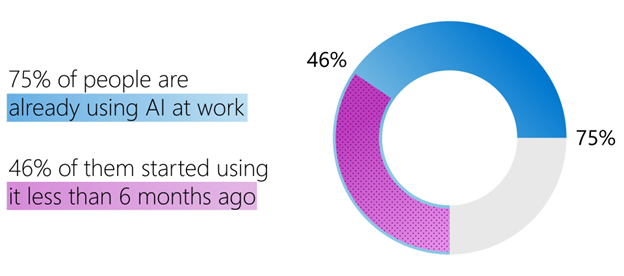
75% of knowledge workers use AI at work today
60% of leaders worry their organization lacks a plan and vision to use generative AI
78% of those using generative AI are using personal tools from outside the organization
Cybersecurity and data privacy is leadership’s top concern for the next 12 months.
75%! Sounds like AI is almost fully deployed around the world. That may look like a lot of usage, but most of it is unplanned and lacks required security and risk controls.
Digital Work
Despite all the investments in flexible work technologies since the start of the COVID-19 pandemic, the digital weight of work hasn’t changed. 68% of the workforce struggles with the pace and volume of work.
Meetings and after-hours work have not declined. Three years after the release of Microsoft Viva – the employee experience platform -- over half of the average workday is spent catching up on communications (chats, meetings and especially email) and not in productivity.
AI may be able to help, with a growing range of leaders expecting to see broader deployments soon. However, necessary AI skills and training, while in demand, can be hard to find or fund. For the vanguard of early adopters, Microsoft notes that AI power users show reduced time in meetings and communications, and more time for creating content in Office.
The Microsoft WTI report closes with three recommendations:
Apply AI to every business problem
Deploy AI top-down and bottom-up [everywhere!]
Prioritize training everyone
Synozur Research
That’s a lot to unpack. Let’s look at what we’ve found in our own research.
In May, Synozur surveyed customers at the Microsoft 365 Community Conference,and found:
Over 53% had little or no experience with AI. We think this stems from AI being blocked at many companies, and from misunderstandings about LLMs in general.
About 49% have little or no use of AI across their organizations.
Based on a word-cloud exercise, the most common impressions were:
“security” “cost” “interesting”
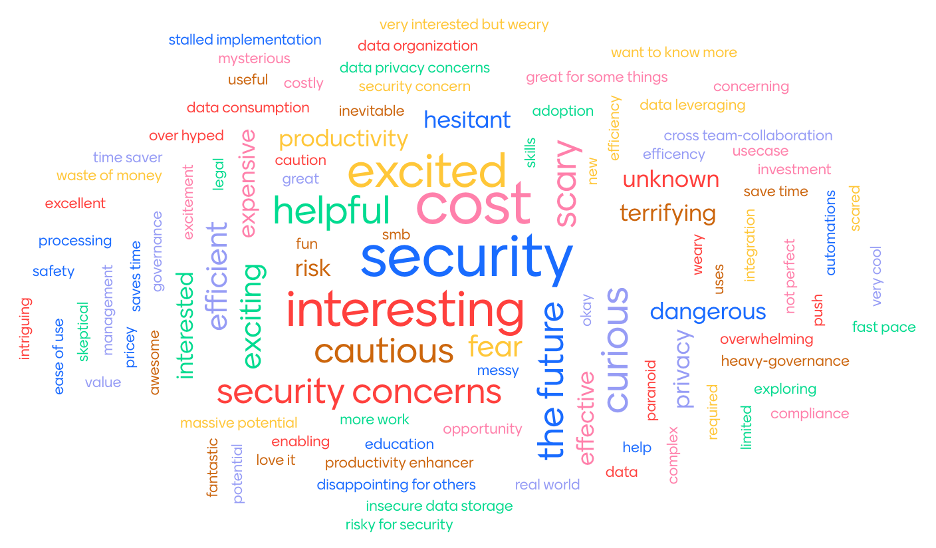
Based on our own research, most organizations are not yet using generative AI at scale. Most of that AI usage is experimental and uses uncontrolled “shadow AI” – unsecured, unverified and with unpredictable results.

So how should we proceed with generative AI when it seems we’re still facing significant challenges form the digital “weight of work”, and a lack of AI skills across the modern workforce? Is Microsoft putting the cart before the horse?
We wholeheartedly agree that GenAI – and Copilot specifically -- has huge potential to transform digital work and address many of these post pandemic pain points. But a failed AI deployment will drain resources and leave productivity and skilling concerns unaddressed.
Additionally, the adoption of Microsoft Copilot can be influenced by an organization’s maturity in using Microsoft Teams. Here’s how:
User Empowerment: Organizations with mature Teams adoption are likely to have empowered users who are comfortable with collaborative tools. This familiarity can ease the transition to Copilot, as users are more open to AI-driven assistance1.
Change Management: If Teams adoption is low, it indicates a need for robust change management strategies. Copilot adoption requires similar planning, training, and executive sponsorship to drive successful implementation.
Skills Transformation: Teams maturity often correlates with upskilling efforts. Organizations with a strong learning culture are better positioned to embrace Copilot’s capabilities and integrate them into their workflows.
What to do
First, don’t worry. You’re not behind your competition. That 75% usage number in the WTI seems large, but it’s mostly individual experimenters who may have tried ChatGPT once or twice at work.
Second, those security concerns are real – and avoiding a centralized approach means that “shadow AI” will add risks, security concerns, and declining confidence in AI that could set back any other implementation for years, or indefinitely. AI can aggregate information at scale across any organization rapidly – but even Microsoft’s Copilot relies on the underlying security and accuracy of the content used to create tailored responses. Other Ai systems can inadvertently expose internal data to the public, or create answers based on external sources of dubious quality.
Enabling AI for everyone, everywhere all at once isn’t a plan. Here are some principles that Synozur uses to guide our client’s approach to AI deployment.
Planning
Ethical Guidelines: Develop clear ethical guidelines for the use of generative AI to address concerns about bias, privacy, and job displacement, fostering trust in the technology.
AI Governance: Set up an AI governance framework to oversee the ethical and responsible use of generative AI within the organization.
Leadership Endorsement: Secure the endorsement of generative AI initiatives from top management to signal its importance and encourage organization-wide acceptance.
Cross-Functional Teams: Form cross-functional teams that include AI experts and end-users to facilitate the exchange of ideas and ensure the technology meets user needs.
Deployment
Pilot Projects: Implement pilot projects that demonstrate the value of generative AI in real-world scenarios, which can then be scaled across the organization.
Strategic Integration: Integrate generative AI into strategic business areas where it can have immediate impact, such as customer service, marketing, and product development.
Custom Solutions: Encourage departments to develop custom generative AI solutions tailored to their specific challenges and goals.
Visibility and Accessibility: Make generative AI tools and resources easily accessible to all employees, and ensure their benefits are visible and understood across the organization.
Feedback Mechanisms: Implement robust feedback mechanisms to gather insights from employees on the use of generative AI, and use this feedback to drive improvements.
Adoption
Educate and Inform: Start with workshops and seminars to educate employees about the benefits and capabilities of generative AI. Highlight how it can streamline tasks and foster innovation.
User-Friendly Tools: Provide user-friendly generative AI tools that require minimal technical expertise, allowing a broader range of employees to engage with the technology.
Success Stories: Share success stories and case studies of generative AI within the organization to illustrate its potential and encourage adoption
Incentivize Usage: Create incentive programs that reward departments or individuals who effectively incorporate generative AI into their workflows.
Continuous Learning: Establish a culture of continuous learning and improvement, where feedback is used to refine and enhance generative AI applications.
Community Building: Build a community of practice around generative AI to share knowledge, best practices, and foster a sense of collective progress.
By adopting these strategies, organizations can create a conducive environment for the adoption and effective use of generative AI, ultimately driving innovation and competitive advantage.
Learn more
We have even more guidance to share!
Next month, Synozur will be discussing the findings with our partners at Akumina at 8:00AM PDT for our July 16th webinar “Navigating AI: Explaining the Microsoft Work Trend Index”. Register now at Microsoft Virtual Events Powered by Teams
You may also have specific questions about your organization’s approach to AI. Why not schedule a free consultation with us at Synozur AI Strategy North Star Workshop — The Synozur Alliance
Thanks, and hope to see you on July 16.