How AI, Metadata & Human Experience Shape Enterprise Knowledge
The Data Tide & the AI Imperative
If you sometimes feel awash in information, you’re not alone. Analysts estimate that our world generates roughly 2.5 million terabytes of new data every day and that 90 percent of all existing data has been created in just the past two years. This explosive growth is a double-edged sword: organizations have more input than ever, but the sheer volume can bury insights and distract employees from what matters.
When I sat down with Adam Harmetz, Corporate Vice President for SharePoint at Microsoft, we agreed that the question for business leaders isn’t whether artificial intelligence will change knowledge work — it’s about how to make the most of it. We both see modern intranets evolving from static file repositories into smart, AI-driven brain trusts that surface context and meaning.
The Scale of SharePoint – A Billion Users & Beyond
First, let’s appreciate the scale of today’s collaboration platforms. Microsoft reports that SharePoint now serves over one billion users worldwide and processes more than two billion pieces of content every day. That’s a staggering leap from its origins as an on-premises portal in the early 2000s and signals that SharePoint has become the knowledge backbone of Microsoft 365.
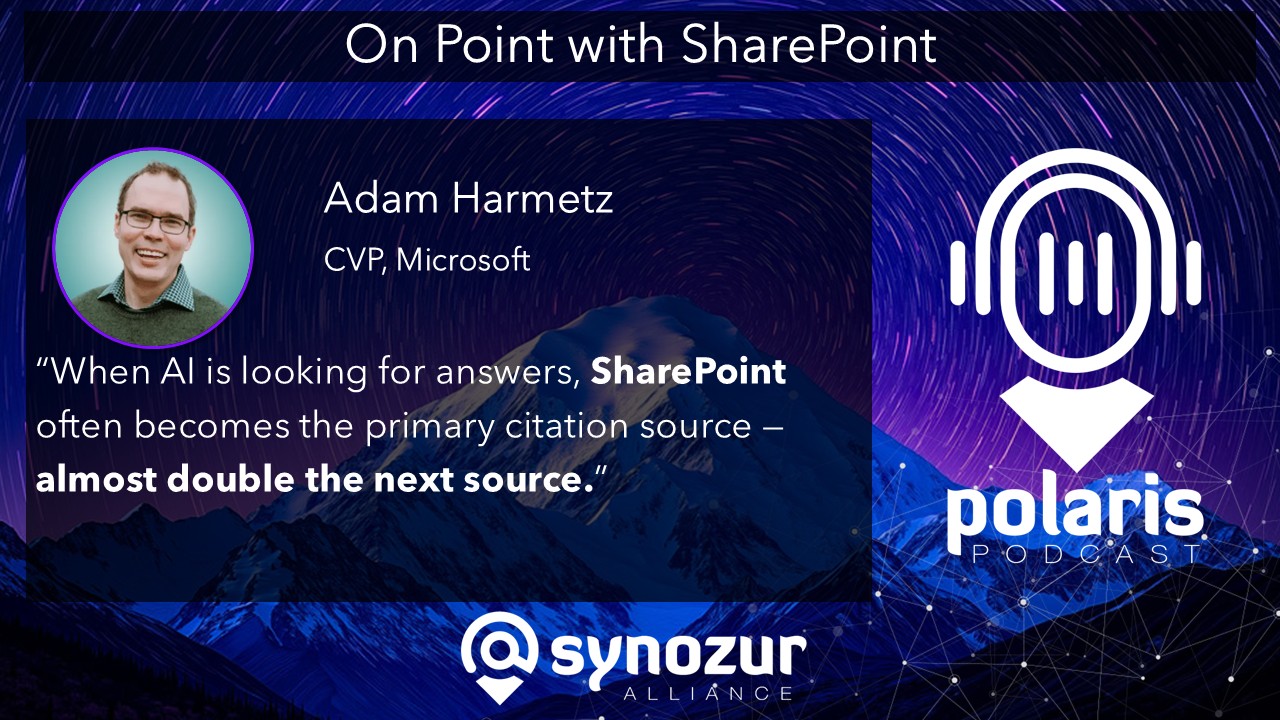
And there’s good reason for that ubiquity. Unlike rigid databases or unstructured email threads, SharePoint offers a unique sweet spot: it’s semi-structured enough to apply meaningful metadata while remaining collaborative and user-friendly. This flexibility makes SharePoint not just a storage tool but an ideal substrate for enterprise AI. In fact, it’s already the primary citation source for Copilot, doubling the next-closest source.
From Drudgery to Insight: Why Knowledge Agents Matter
Despite these strengths, knowledge workers still spend nearly 19 percent of their workweek searching for and gathering information. That’s almost a day each week drained away by the constant hunt for documents. No wonder 77 percent of companies are using or exploring AI and about 65 percent of organizations are already using generative AI to improve productivity.
This need to cut through the clutter inspired Microsoft to launch the Knowledge Agent for SharePoint. This built-in assistant automatically tags and classifies documents, suggests new metadata fields, flags outdated pages and broken links, and even helps content owners build new pages with context-aware prompts. When content is enriched with metadata, Copilot can reason over it deterministically, filtering and sorting results by business context.
And just in time for Ignite, Adam announced that the Knowledge Agent will come out of preview in January – and it will be automatically included with M365 Copilot. You’ll also be able to turn it on or off site by site. [Adam on LinkedIn]
Preparing for Multiple Futures
The AI landscape is evolving rapidly. Early in 2023, ChatGPT reached over 100 million monthly active users within two months of launch, making it one of the fastest-growing consumer apps in history. Meanwhile, Google’s Nano Banana model shows how AI can remix and edit photos through simple prompts, and OpenAI’s Sora 2.0 video generator produces realistic video clips directly from text or images.
It’s tempting to imagine a completely chat-centric workplace where everything flows through AI, but Adam emphasizes that we must prepare for multiple possible futures. Will chat replace portals entirely? Or will we still need rich, branded intranets for discovery, sharing and culture? The answer, he suggests, is likely a blend: a “split world” where humans and AI agents co-evolve. That’s why it’s critical to get your content ready today—so that whichever path emerges, your information remains accessible, secure and compliant.
The Human Element & Community
One of the most encouraging parts of our conversation was hearing Adam reflect on the SharePoint community. He sees a “sign of respect” when people invest their careers in a platform and emphasizes the importance of nurturing, informing and listening. At Synozur, we couldn’t agree more. Our brand has always been about building trust, meeting clients where they are and tailoring solutions that amplify human insight rather than replacing it.
Polaris is available on Apple, Spotify, Amazon, YouTube or wherever you get your favorite podcasts. Thanks.
Show Notes
Takeaways
Data volume is exploding: Our world generates around 2.5 million terabytes of data every day and 90 percent of existing data was created in the last two years. Harnessing this data tsunami requires AI-powered tools that curate and surface the right information at the right time.
AI adoption is mainstream: Studies show over 77 percent of companies are either using or exploring AI to drive productivity, and about 65 percent of organizations are already using generative AI to improve operations.
Searching wastes time: Research suggests that knowledge workers spend nearly 19 percent of their workweek searching for and gathering information. AI-driven knowledge agents present a huge opportunity to reduce that overhead and focus teams on higher-value tasks.
SharePoint’s massive scale: SharePoint now serves over a billion users worldwide and processes more than two billion pieces of content every day. It has evolved from a portal into the collaboration and knowledge backbone of Microsoft 365.
Intelligent content curation: Microsoft’s new Knowledge Agent enriches documents with metadata, analyzes pages to fix broken links, retires outdated pages and creates new pages from simple prompts. Enriched metadata enables Copilot and agents to deliver deterministic, context-aware answers.
Preparing for multiple futures: Adam Harmetz argues that work will likely involve a blend of chat-centric AI experiences and rich, branded intranets. Organizations should ensure their content is AI-ready and prioritize clear governance and metadata so they can pivot as technology evolves.
The human element: SharePoint’s passionate community underscores the importance of trust and empathy. Adam stresses nurturing, informing and listening to people who place their careers on a platform.
Sound bites
Adam Harmetz, CVP for SharePoint, Microsoft
“When AI is looking for answers, SharePoint often becomes the primary citation source—almost double the next source”.
“Semi-structured data in SharePoint is the sweet spot for enterprise AI: structured enough to apply more structure, yet collaborative enough to capture everyone’s voice”.
“The future won’t be a clean break; it will be a split world where humans and agents co-evolve and reason over shared data stores”.
“In these paradigm shifts, it’s better to ask why and how than to dwell on why not — great product making happens when we respect our customers’ trust and solve real pain points.”
References
Industry
Data growth statistics: Our discussion referenced IFLScience’s report noting that the world produces roughly 2.5 quintillion bytes (≈2.5 million terabytes) of new data each day, and 90 percent of existing data has been created in the last two years.
ChatGPT adoption: We noted that ChatGPT amassed 100 million monthly active users within two months of launch, making it the fastest-growing consumer app in history.
AI adoption statistics: According to AI Statistics, 77 percent of companies are using or exploring artificial intelligence in their operations. The CloudFactory blog cites McKinsey research indicating that about 65 percent of organizations were actively using generative AI by late 2025.
Knowledge worker productivity: A Forbes column summarizes an IDC/McKinsey study showing that knowledge workers spend roughly 19 percent of their time searching for and gathering information.
SharePoint usage: Microsoft reveals in its SharePoint blog that customers add over two billion pieces of content every day. At the 2025 M365 Community Conference, Jeff Teper announced that SharePoint has surpassed one billion users and runs two billion Power Automate flows each week.
Knowledge Agent: Microsoft’s official blog post “Introducing Knowledge Agent in SharePoint” outlines how the agent enriches and organizes content, suggests metadata columns, fixes broken links and helps build AI-friendly pages.
Metadata & deterministic AI: Another SharePoint showcase explains how metadata understanding yields more precise, context-aware answers from Copilot and agents.
AI models: Google’s generative image model Nano Banana can combine and edit images based on natural language prompts, while OpenAI’s Sora 2.0 video generator offers realistic, multi-shot video creation from text and images.
Historical context: We mentioned the Library of Alexandria, the ancient repository that sought to collect every book in the world.
Guest Links
Book reference: Adam recommended the Dungeon Crawler Carl LitRPG series by Matt Dinniman.
Guest links: Connect with Adam Harmetz on LinkedIn
Personal Blog (with Helen Harmetz): Mind the Beet
Events
Microsoft Ignite 2025 – Nov 17-21, 2025 (San Francisco, CA).
ESPC25 (European SharePoint Conference 2025) | Dec 1-4, 2025 (Convention Centre Dublin (CCD) Dublin, Ireland).
Copilot and the Company OS | January 4, 2026 (Webinar)
Production
Polaris is produced with help from Riverside.fm. Our theme song, “Alternative Dream” is provided courtesy of Adobe. Additional music and sound provided by IndieGuy Records. Graphic design by Josh Brantley.
Polaris is available on Apple, Spotify, Amazon, YouTube or wherever you get your favorite podcasts. Thanks.
Chapters
00:00 Introduction to Adam Harmetz and Career Journey
05:42 The Impact of AI on Knowledge Management
08:38 SharePoint as the Knowledge Engine for Co-Pilot
11:25 The Future of SharePoint and AI Integration
13:57 Community Influence on Product Development
16:59 Challenges Faced by Customers and Solutions
19:46 AI's Role in Product Design and Development
22:26 The Importance of Trust in Technology
25:15 Reflections on SharePoint's Legacy and Future
27:52 Closing Thoughts and Personal Insights
29:10 Customer Opportunities
35:30 Billion User Legacies
37:23 SharePoint Year 25 - Year 50
38:44 Personal Views on Pop Culture
40:57 Upcoming Tech Events
42:06 The Journey of Knowledge Management
43:32 Next on Polaris
44:05 Conclusion