We ran our new 2026 AI Adoption and Governance maturity model with the room at TechCon 365 this month. (you can try it here 2026 AI Adoption & Governance).
Eighteen leaders graded their own organizations, fast, across three things: the tools their people can reach, the governance steering how those tools get used, and the economic oversight that proves any of it pays off.
The average organization landed at 257 out of 500. That is “Managed.” Repeatable at the team level, not yet run with data. And not one respondent reached the next tier up. In a room full of motivated, AI-forward people, nobody could yet say they manage AI by the numbers instead of by instinct.
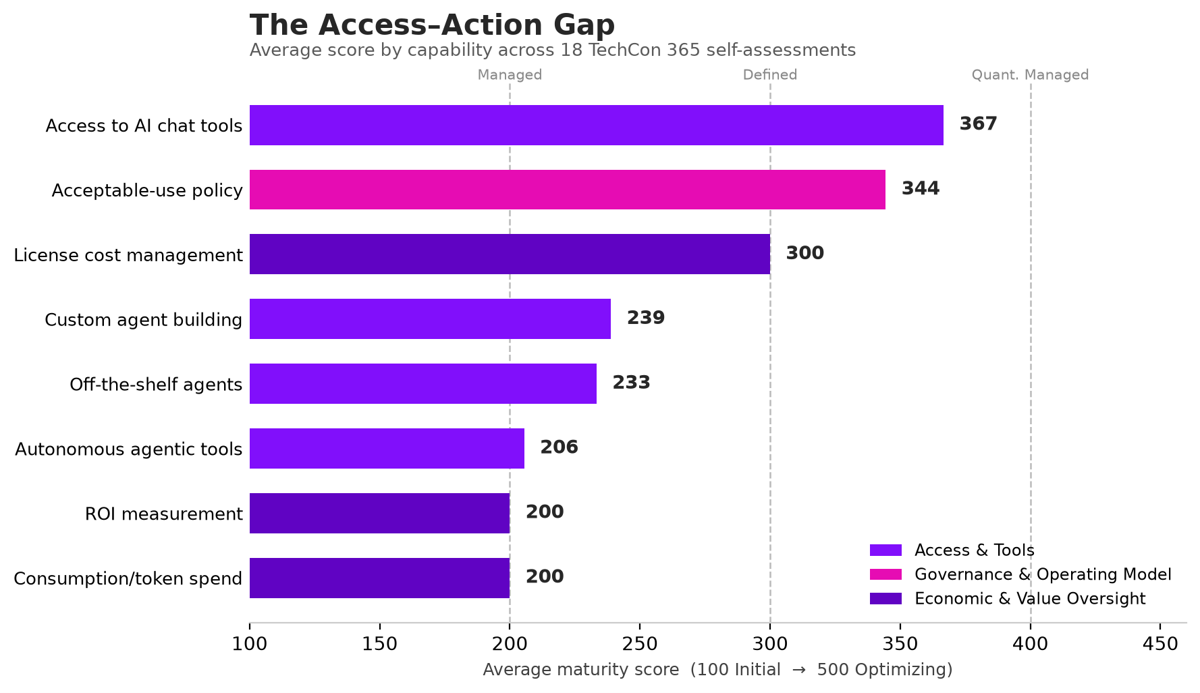
Access is solved. Action isn’t.
The highest-scoring question, by a wide margin, was access to AI chat tools. Half the room has universal, IT-managed access. Copilot, ChatGPT, Gemini, Claude, provisioned like any other part of the kit. That is real progress, and it is worth saying out loud.
Then the scores fall off a cliff. Ask about the autonomous, agentic tools that actually compress work, the research agents, the coding agents, the long-running assistants, and seven of eighteen use none at all. Only two have them running in production. The gap between “we have chat” and “we put agents to work” was 161 points.
The chat box is the on-ramp. It is not the destination. Most organizations parked on the on-ramp and called it a strategy.
The harder question: is it working?
For most of the room, the honest answer is - we don’t know. Eight of eighteen do not measure the ROI of AI at all. A few more rely on what one of our answer choices called, bluntly, “ad hoc storytelling.” A good anecdote in a status meeting. Only two measure revenue impact.
Cost tells the same story. License spend gets tracked, because it is a tidy line item. The moment spend goes variable, (hello Cowork!) the pay-as-you-go consumption that every agent runs on, visibility disappears. Eight of eighteen described their token spend as uncontrolled. That is a problem you can ignore this quarter and cannot ignore next year, because variable spend is the part of the bill that grows.
Policy on paper, muscle in practice
Governance was the strongest dimension overall. Look closer and one thing is carrying it: a published acceptable-use policy. Most organizations wrote down the rules. Far fewer built the people structure that turns rules into capability.
Thirteen of eighteen named IT and the help desk as their main AI support model. Two had a Center of Excellence. Three were running real training or an AI academy. Four had a cross-functional steering committee. A help desk can reset your password. It cannot teach your finance team to rebuild the monthly close around an agent.
What I would do Monday
The pattern across all eighteen is clear. It’s fixable.
Maturity is no longer gated by access. Access is mostly won. It is gated by operating muscle. Three moves, in order:
Measure something real. Pick two workflows and track time, cost, and outcome. Stories do not survive a budget review.
Put a number on variable spend before it puts a number on you. Set a token budget, wire up alerts, name an owner.
Build the scaffolding. A help desk keeps the lights on. A Center of Excellence and real training are what move you up a tier.
The organizations that break into the next level in 2026 will not be the ones with the most licenses. They will be the ones who can answer three questions the rest of the room could not. What did it return? What did it cost? And who owns making it better?
If you want to see where you land, the model is open. The most useful conversation usually starts with your lowest score.
Based on 18 self-assessments completed at TechCon 365 in June 2026. Self-reported and self-selected, so read it as direction, not a census.