Most CEOs are not short on AI ambition.
They are short on proof.
The pattern is familiar. Teams buy licenses. A few leaders champion pilots. Someone builds a deck about transformation. Six months later, the business still cannot answer the only question that matters: what changed in revenue, EBITDA, productivity, or decision speed?
That distinction sounds small. It isn't.
AI does not fail because leaders lack interest. It fails because most organizations are trying to add AI to an operating model built for a different era. If your roles are unclear, your governance is loose, your data is fragmented, and your managers do not know what good adoption looks like, more tools will not fix the problem.
An AI-first operating model will.
Why AI investments stall
The market has moved from curiosity to pressure. Boards expect a point of view. Employees expect better tools. Competitors are moving faster. Even the labor market is adjusting, with OpenAI, Anthropic, Amazon, and Microsoft backing a $500 million worker retraining push reported by TNW. At the same time, model competition is driving capability up and cost down, as The New York Times recently noted in its reporting on lower-cost Chinese AI models gaining ground.
That should make AI easier to access. It does not make it easier to use well.
This is where many companies get stuck. They confuse access with advantage.
What usually stalls progress?
AI spend without a business case tied to a measurable outcome
Pilot activity without clear ownership after the test phase
Undefined roles for governance, adoption, risk, and process redesign
Leadership teams that want speed, but do not change how decisions get made
Change programs that treat employee resistance as the problem, when confusion is the real blocker
Large firms often respond with more technology planning. Software vendors respond with more product. Neither solves the root issue if the business itself is still running on yesterday's assumptions.
What an AI-first operating model actually changes
An AI-first operating model is not a slogan. It is the practical redesign of how work gets done, how decisions get made, and how value gets measured.
That includes a few things most companies skip.
First, a clear North Star. Not a vague innovation goal, a concrete definition of what AI is supposed to improve. That could be forecast accuracy, faster quoting, lower service cost, shorter cycle times, or better conversion. If the target is fuzzy, the program will be too.
Second, explicit roles. Someone owns governance. Someone owns business adoption. Someone owns data readiness. Someone owns outcome tracking. In many mid-market organizations, these responsibilities are implied rather than assigned. That worked before. It will not work now.
Third, operating cadence. AI cannot live as a side project managed through occasional updates. It needs a rhythm for prioritization, review, experimentation, and decision-making. Otherwise the company creates noise, not momentum.
Fourth, human-centered adoption. This matters more than most tech-first plans admit. Employees do not need a lecture on why AI is important. They need clarity on what changes in their job, what does not, what good use looks like, and where human judgment still decides. Our view is simple: AI accelerates, experts decide.
That is why our own guardrails are straightforward and publishable: ASK → REVIEW → EDIT → REPEAT. Nothing goes to a client without human review. No actual impersonation of a person, ever. No AI slop shipped as strategy.
The ladder most teams need to climb
Not every company is ready to become AI-first tomorrow. Pretending otherwise helps no one.
A better frame is a progression:
AI-ready: you assess data, workflows, risk, and leadership alignment
AI-enabled: you launch practical use cases with clear owners and measured outcomes
AI-first: you redesign operating rhythms, roles, and decisions so AI is built into how the business runs
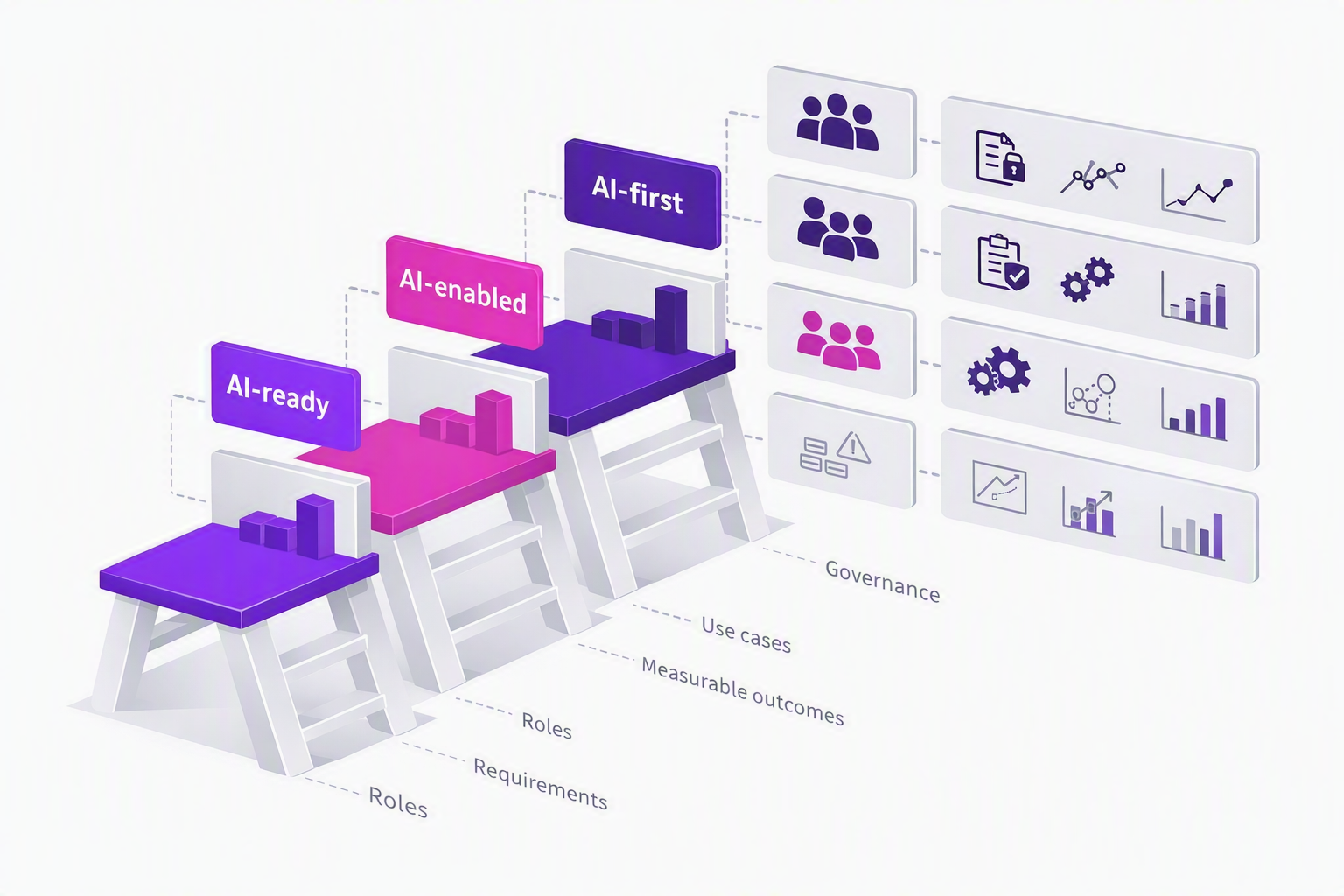
This is where a lot of firms overcomplicate the story. They either pitch enterprise-scale reinvention on day one, or they stay stuck in endless pilot mode. Neither fits the reality of a founder-led or PE-backed company that needs movement fast, but cannot afford chaos.
The better path is controlled acceleration.
Start with the use cases that matter to the P&L. Build governance early, not after a scare. Redesign decision rights before friction shows up in execution. Then track outcomes in language the CEO, board, or sponsor actually uses.
If the metric does not matter in an operating review, it probably should not anchor your AI plan.
Why this matters more for founder-led and PE-backed companies
Urgency looks different when the clock is real.
A founder-led CEO does not have time for a twelve-month strategy exercise that ends in a slide deck. A PE-backed company does not get credit for experimentation without a value creation path. Both need the same thing: strategy-to-execution accountability, without the drag of a giant implementation bureaucracy.
That is where many competitors miss the mark. Big firms bring scale, platform depth, and process. That can help. It can also slow decisions, over-standardize the work, and tilt recommendations toward the tools they already know how to deploy. Smaller firms may move fast, but too often stop at advice or lean on generic change language.
The gap in the market is practical and specific: a partner who can help leadership define the AI-first operating model, align the organization around it, and stay accountable for measurable business outcomes.
That means the work has to be tailored. A retail CIO needs a roadmap tied to forecasting, labor efficiency, inventory, and customer experience. An operations leader in manufacturing needs practical automation and predictive maintenance use cases tied to downtime and error reduction. A PE operating partner needs a repeatable framework that works across portfolio companies without forcing one rigid methodology on every business.
Different context, same standard: measurable outcomes, human-centered adoption, and a clear operating model.
The shift leaders should make now
The old framing is, "we need an AI strategy."
The better framing is, "we need a business that can produce AI ROI repeatedly."
That changes the conversation.
It moves leadership away from tool selection as the main event. It puts focus where it belongs: operating design, accountability, governance, adoption, and outcomes. It also lowers risk, because companies stop chasing shiny objects and start building a system that can absorb change without breaking.
You do not need more AI theater.
You need a way to connect ambition to execution, and execution to measurable results.
That is the job of an AI-first operating model.
If your team is investing in AI but still cannot point to clear ROI, start there. Map the decisions, roles, governance, and metrics before you buy the next tool. Then build from AI-ready to AI-enabled to AI-first with a plan the business can actually run.
If you want a clear outside view of where your operating model is blocking AI ROI, book a strategy session with Synozur. We will show you where the friction is, what to fix first, and how to tie the work to outcomes that matter.