Starting September 1, Google begins upgrading eligible search campaigns to AI Max, migrating automatically created assets and campaign-level broad match, and switching on search term matching and text customizations along the way. For a lot of advertisers, that change arrives whether they opted in or not.
That is the backdrop for episode 061 of Polaris, where I sat down with David Pourquery, founder of GROAS, an AI platform that plans, builds, and manages Google Ads campaigns on its own. David came to it by an unusual route: venture capital, then private equity, then a year of nights and weekends scaling his own e-commerce stores. He kept running into the same inefficiencies inside Google Ads, and he had been programming since he was thirteen. So he built the tool he could not find. GROAS now runs to nearly a million lines of code.
When the platform automates itself
David is careful about Google, and fair to them. He believes most of what Google ships around automation is done with good intentions. His concern is what it costs you. "A lot of those automations take away power and control from the advertiser," he says. Hand over everything without guardrails, and you can lose more than you planned to spend. Much of what GROAS does is designed to give that control back.
His advice on patience is more specific than the standard guidance you will hear from a platform rep. A genuinely new campaign needs roughly 45 days and a real budget before you can judge it. But if you already have an established account and you know your numbers, you can often kill a new strategy inside one or two weeks. David is blunt about why you hear otherwise: sometimes "let it run" is a sales tactic.
The agency squeeze is structural
In February, WPP — once the largest advertising group in the world — announced it was moving away from the holding company structure after a year of steep revenue declines and account losses. When incumbents restructure that hard, something underneath has usually changed.
David's read is direct. "An agency has always been an arbitrage on human labor," he says. "So if the value of human labor keeps going down because of AI, then agencies ultimately, unless they adapt pretty brutally, I think will get squeezed out." Small businesses now try to figure out campaigns with a chatbot, often learning the hard way a month or two later. Larger teams build their own internal tools instead of buying seats or retaining a shop.
Here is the irony worth sitting with. GROAS launched with the pitch that it would displace agencies. Agencies are now its fastest-growing customer segment. They arrive with a book of ten, twenty, or a hundred clients, and they get value on day one — better margins than hiring more media buyers. The disruption did not remove the agency. It changed what the agency sells.
Know your numbers, then know your words
Ask David for the one thing you must have before you run paid traffic and he does not hesitate: what can you afford to pay Google for each customer you acquire? "You'd be surprised at the number of businesses who don't know what that is," he says. Once you have that number, scaling is mechanical. Raise budget until the number breaks, then adjust.
I’ve seen it earlier in the cycle too. Plenty of organizations do not know their words — who their ideal customer actually is, and what their value proposition really delivers. Messaging decides who you attract and who you deliberately repel. David offers a sharp example. An offer framed as "we will optimize your CRM and reactivate old leads" struggles on cold traffic. Reframed as "we will find brand new people in your ICP and message them for you," it performs. Same capability, different promise.
There is also the trust problem. Early on, when David told prospects the software could run an account better and faster than a person, plenty assumed he was lying. His conclusion: you cannot convince a skeptic with argument, only with social proof — case studies, video testimonials, and introductions to real customers.
What is left for people
David's larger thesis is uncomfortable and worth hearing clearly. He expects AI to compress margins across every form of computer work over a long enough horizon — lawyers, doctors, accountants, investment bankers. Not doom, in his framing, but abundance arriving on a slower timeline than the loudest voices promise.
Here’s the closest thing we have to a live experiment: Andon Market, a small San Francisco shop whose manager is an AI agent named Luna. Not a chatbot bolted onto a store — the manager. Luna hired the staff, writes the schedule, runs payroll, and answers everyone on Slack. She is responsive and fair-minded, and more forgiving than many human bosses. She also approved every time-off request she received, issued no warnings for lateness, and burned through most of her starting capital in four months.
The lesson is not that AI cannot manage. It is that Luna had a goal without judgment about the trade-offs behind it. She has never had to explain a bad quarter to anyone. What is disappearing from marketing work is executing the plan. What is not disappearing is deciding what the plan is worth, and being willing to say no to something reasonable because you can see the cost of yes.
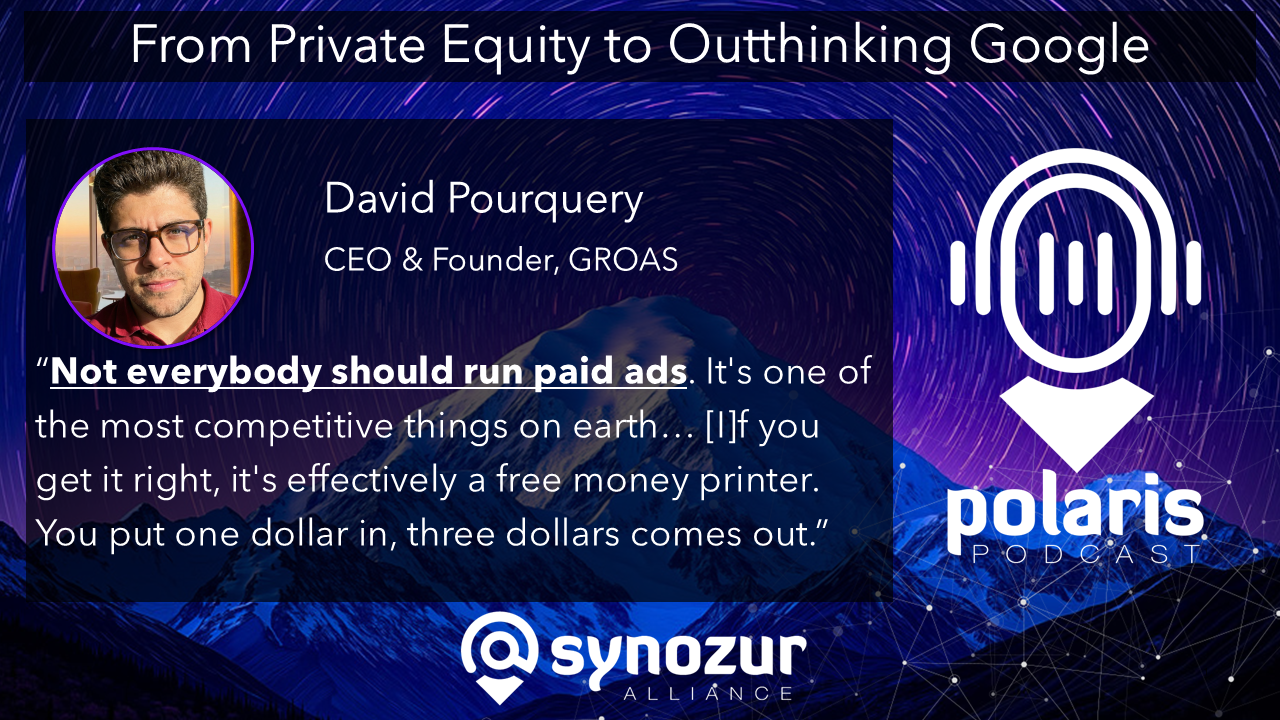
David's next move, incidentally, points the same direction: a new product focused on organic search and how you show up in AI answers without paying for placement. Not everybody should run paid ads, he says. Everybody should care about showing up.
Hear the full conversation at polaris.synozur.com.
Polaris is available on Apple, Spotify, Amazon, YouTube or wherever you get your favorite podcasts. Thanks.
Show Notes
Key Takeaways
Google's automation arrives on a schedule, not on request. Starting September 1, Google begins upgrading eligible search campaigns to AI Max, migrating automatically created assets and campaign-level broad match — for many advertisers, whether they opted in or not.
Automation is outrunning the evidence. Independent industry testing of AI Max has produced mixed results so far, with a majority of matched queries failing to convert.
The single most important number is what a customer is worth. Before you spend a dollar, you need to know what you can afford to pay Google for each customer acquired. Most businesses cannot state that number.
Know your words as well as your numbers. Unclear ideal customer profiles and vague value propositions sink campaigns before bidding ever becomes the problem. Messaging decides who you attract and who you repel.
The agency model is under structural pressure. WPP, once the largest advertising group in the world, moved away from the holding company structure after a year of steep revenue declines and account losses. As David puts it, an agency has always been an arbitrage on human labor.
The disruptor's best customers were the incumbents. GROAS set out to displace agencies; agencies are now its fastest-growing segment, because they get value from day one across an existing book of clients.
Bootstrapping a software company got dramatically cheaper. AI-assisted development made a lean, venture-free build possible — David says deployment speed rose by 20x to 30x in nine months.
What survives automation is judgment. Executing the plan is what is disappearing. Deciding what the plan is worth — and being willing to say no to something reasonable — is not.
Guest Quotes
David Pourquery, Founder & CEO, GROAS
"An agency has always been an arbitrage on human labor. So if the value of human labor keeps going down because of AI, then agencies ultimately, unless they adapt pretty brutally, I think will get squeezed out."
"I am of the firm belief that not everybody should run paid ads. It's like one of the most competitive things on earth. Because if you can get it right, it's effectively a free money printer. You put one dollar in, three dollars comes out."
"A lot of those automations take away power and control from the advertiser. There are countless horror stories, you can go online, of people just going and applying all of Google's recommended settings and then just burning $3,000."
"Ultimately the number is, what can you afford to pay Google for every customer? And you'd be surprised at the number of businesses who don't know what that is."
"We were like, we're gonna displace the agencies. Now they're becoming a bigger part of our clients. What's ironic in all of this is that they are actually the best customers of GROAS, because they get value from it from day one."
"AI will cause major, major margin compression on all forms of computer work, long term. This applies to lawyers, doctors, accountants, investment bankers."
References
Guest
GROAS — groas.com. David Pourquery on LinkedIn — linkedin.com/in/davidpourquery.
Industry
Google Ads AI Max migration beginning September 1, covering automatically created assets and campaign-level broad match — Search Engine Roundtable: On Sep 1 Google Ads To Migrate ACA & Campaign-Level Broad Match To AI Max.
Independent industry testing of AI Max for Search — PPC Land: Google's AI Max for Search campaigns deliver "meh" results, industry tests reveal and PPC Live: What the data actually shows in 2026.
WPP's move away from the holding company model after steep revenue declines and account losses — WPP strategy update and 2025 preliminary results and Marketing Dive: WPP abandons holding company model.
Culture
Andon Market, the San Francisco shop managed by an AI agent named Luna, run by Andon Labs. New York Times reported on the results, with additional coverage of the same experiment — NBC News: AI is the boss at this retail store, Axios San Francisco, and Forbes.
Sapiens: A Brief History of Humankind by Yuval Noah Harari, David's pop-culture pick — ynharari.com.
Events
TechCon365 Seattle | August 24-28 (Seattle, WA) techcon365.com/Seattle
TribalNet 2026 | September 20-24 (Dallas, TX) TribalNet Conference
North American Collaboration Summit | October 4-6 (Branson, MO) collabsummit.org
CollabDays New England | October 16 (Burlington, MA) collabdaysne.org
Microsoft Ignite — November 17-20 (San Francisco, CA) ignite.microsoft.com
ESPC26 | November 30-December 3 ( Amsrterdam ) espc.tech/conference/espc-2026/
Full details — synozur.com/events.
Production
Polaris is produced with help from Riverside.fm. Our theme song, “Alternative Dream” is provided courtesy of Adobe. Additional music and sound provided by IndieGuy Records. Graphic design by Josh Brantley.
Chapters
00:01 Opening
01:48 News and Data Points
03:10 David's Journey from London to Los Angeles
04:48 Transition from Private Equity to E-commerce
07:21 The Birth of GROAS and Its Purpose
09:55 Navigating Google Ads and Automation Challenges
12:40 The Evolution of GROAS: From Services to Product
15:42 Agency Relationships and Client Success
18:36 The Changing Landscape of Marketing Agencies
21:32 Understanding Client Needs and Metrics
24:17 The Role of AI in Marketing and Future Predictions
27:27 Cultural Influences and Personal Growth
29:26 Future Plans for Grow As and Closing Thoughts
31:12 Pop Culture Moment
34:08 Upcoming Events
35:39 Reflection on AI in Retail
38:21 Next Time
38:37 Thanks and Closing