Every leadership team crafts a strategic plan for the new year. Yet 2 out of 3 such strategies fail to fully deliver. The culprit isn’t a lack of vision – it’s the lack of a system and culture to execute that vision. As we enter the final stretch of 2025, ask yourself: Will our 2026 strategy guide our team, or will it gather dust by spring?
At Synozur, we’ve seen this “strategy-execution gap” up close. The good news: it’s fixable. In fact, companies that bridge strategy to execution can outperform their peers by 20–30% over the long run. This article explores how forward-thinking leaders are using a Company Operating System and AI co-pilots to close the gap – turning lofty goals into everyday results.
Why Strategies Fail – The Silent Gap: In boardrooms, strategies sound brilliant. On the front lines, they often fade into a blur of emails and firefights. Research confirms what you may suspect: the issue is not formulation, but execution. Consider:
Alignment – One survey found only ~5% of employees fully understand their company’s strategy. It’s hard to execute what you don’t grasp. Even many middle managers can’t name the top strategic priorities.
Leadership Focus – Urgent issues constantly distract from important ones. A stunning statistic: 85% of executive leadership teams spend less than one hour a month on strategy once the plan is set. Without persistent leadership attention, initiatives lose momentum.
No Operating Framework – Companies often lack a structured way to drive strategy day-to-day. Teams set KPIs and hold meetings, but these aren’t tied together in an intentional rhythm. As a result, strategic initiatives compete with business-as-usual, and often lose.

The cost of this gap is huge – wasted resources, stalled growth, frustrated teams. But some organizations have cracked the code, by adopting what we like to call a Company OS™ (Operating System) for strategy.
What is a Company OS™? It’s a simple idea: treat your strategy as a living process, not a one-time document. A Company OS provides four key building blocks that connect the dots from strategy to execution:
North Star (Business Foundations): A clear and compelling mission, vision, and set of values. This is the guidance system – your “why” and long-term “where to.” When everyone from the board to new hires internalizes the North Star, you create unity of purpose. (If your team rolls their eyes at vision statements, it’s usually because those statements are vague or disconnected from daily work – we fix that.)
Strategic Decisions: A few sharp choices that define how you will win. This includes your core strategies or pillars – e.g., focus on a particular market, differentiate on customer experience, etc. Strategy is about saying no as much as yes. We ensure leadership has truly made – and communicated – the tough choices.
Annual Plan: The translation of strategy into concrete goals, initiatives, and KPIs for the next 12 months (in this case, 2026). If the North Star is the destination, the Annual Plan is the route map for this year’s journey. A strong plan links every project and metric back to a strategic objective. No orphan projects, no pet initiatives that don’t ladder up.
Focus Rhythm: The heartbeat of execution – the recurring meetings and checkpoints (weekly, monthly, quarterly) to review progress, solve problems, and adapt. It’s like an ongoing performance drumbeat that keeps the strategy in focus. This might include a Monday exec huddle on key metrics, a monthly strategy review, and quarterly deep dives. The exact cadence can vary, but the key is that it’s regular and tied to strategic priorities (versus the ad-hoc barrage of status meetings most organizations suffer through).

These four elements work together. When you have all of them, you align your culture and operations around the strategy. People know what needs to be done and feel accountable to do it. Gaps get noticed and addressed in real-time, not at year-end.
Where AI Comes In (Strategy’s New Sidekick)
Here’s where 2025 offers something that 2005 didn’t – affordable, powerful AI tools that can supercharge these processes. A Company OS isn’t inherently digital, but we’ve found that weaving AI into it can yield tremendous benefits: speed, insight, consistency.
A few examples from our recent client work:
After a company offsite defined broad goals, we used an AI workshop summarizer (a specialized large-language model) to turn the facilitators’ notes and whiteboard photos into a first-draft Mission, Vision, and Values document. It did this in minutes, capturing nuances that might take human writers weeks to draft. The leadership team was then able to review and finalize their “North Star” within a day, rather than waiting a month for a polished write-up.
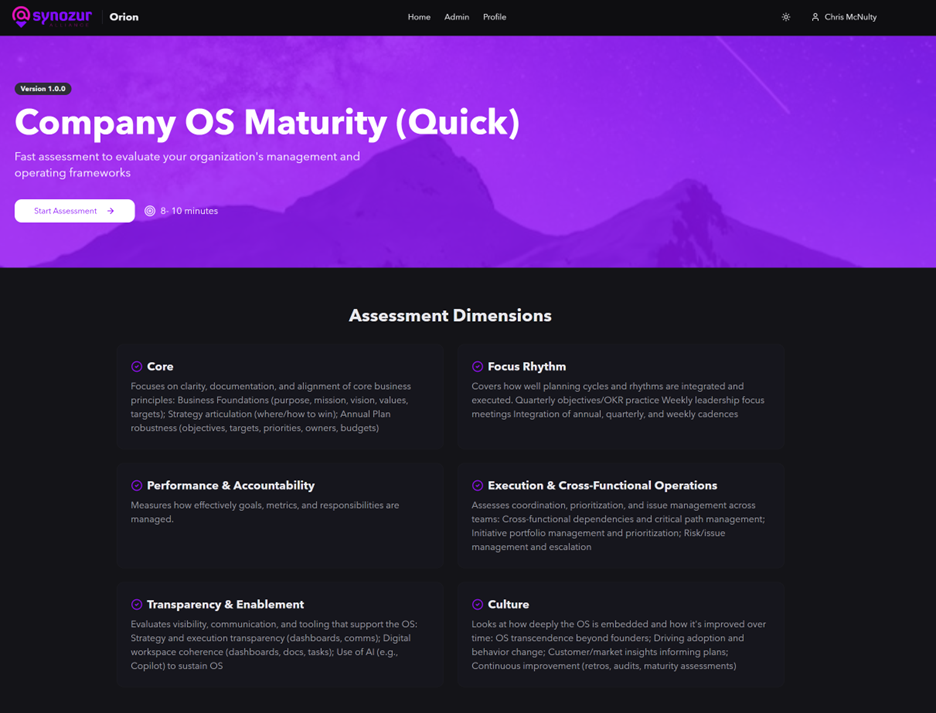
We also use our Company OS Maturity Model to help assess the current state of management and leadership for our clients. We’ve disitilled our best advice into the AI model that provides an initial set of taliored evaluations and roadmaps for improvement.
During execution, teams use our Focus Rhythm Copilot in meetings. Before a weekly meeting, it might send a brief that says, “Of your 10 key metrics, 2 are off-track (red) – Customer Churn and NPS. Here are the likely causes… And here are 3 recent notable accomplishments to recognize.” During the meeting, someone types action items into Teams, and the bot automatically captures them and schedules reminders. This lightens the load on everyone, so leaders can concentrate on decisions and coaching. One VP told us their 30-minute weekly meeting now accomplishes what used to take 2 hours, because it’s so focused.
And for Microsoft shops, we use Copilot to turn their monthly meetings and dashboards into a unified summary – and then use SharePoint AI to automatically build a beautifully crafted update that’s automatically distributed to email, Teams, SharePoint and Viva Engage.
Crucially, AI is not running the show – it’s augmenting the humans who do. The executive team still sets the vision, chooses which AI suggestions to accept, and provides the emotional intelligence and context that no algorithm has. But by handling heavy data lifting and initial drafts, AI frees leaders to lead. It’s the difference between spending your days merging slides vs. spending them talking to customers and strategizing.
Leading with Culture and Board Alignment
A Company OS doesn’t just live with the strategy or ops teams – it’s embraced from the Board of Directors down to the front line. Part of what we implement is a culture of transparency and feedback. For example, we help clients create a simple “strategy update” ritual for board meetings, often supported by an AI-curated dashboard. This ensures the board isn’t surprised at year-end because they’ve been seeing (and guiding) execution in real-time. It also forces tough strategic conversations before things derail.
Culture is often called “the way we do things here.” By establishing a focus rhythm, the “way we do things” becomes: we set goals, we check in openly, we adapt as needed. Over time, this builds trust and accountability. People start to see strategy not as an external mandate but as part of their daily work. And when new strategic initiatives come down the line, there’s far less resistance because the team has a habit of execution.
Importantly, culture and strategy must reinforce each other. For instance, if a company’s value is “Customers first”, in the Company OS that might translate to a practice where every strategy meeting starts with a customer insight. These little cultural habits baked into the rhythm ensure that strategic decisions are made in harmony with the company’s values and day-to-day realities. It’s a feedback loop: culture enables execution, good execution strengthens culture by producing success stories – which in turn reinforces the value of the strategy.
Finish 2025 Strong
As a leader heading into 2026, you have an opportunity right now in Q4. Instead of just hoping everyone executes the brilliant 2026 plan, you can put the mechanisms in place to guarantee it. Think of it like launching a rocket: a clear destination, a solid flight plan, and a mission control to monitor and adjust the trajectory. Most companies have a destination and flight plan; few have mission control.
By adopting a Company OS approach – and leveraging modern tools to accelerate it – you can be one of those few. Imagine in mid-2026, looking back and being able to say: We didn’t just come up with a great strategy – we actually delivered on it. That’s our wish for every client, and it’s why we’re so passionate about this.
Get Involved: This blog kicks off our “Strategy, Now with AI” series. Over the coming weeks, we’ll dive deeper into each aspect of the Company OS and share how you can apply it. We also invite you to assess your own organization with our free Strategy Maturity Assessment tool – it’s 5 minutes, but the insight could be a game-changer (link below). And mark your calendar for January 6, 2026, when we’ll host a live webinar to share more ideas and answer questions from leaders like you.
Call to Action
Ready to close your strategy-execution gap? Start by gauging where you stand – try the Company OS Maturity Assessment (complimentary) and get a tailor-made report.
👉 Complimentary Assessment Link Get your Strategy Blueprint https://aka.synozur.com/cosmml
👉 Free Webinar - January 6 Learn more and register now at https://aka.synozur.com/cos26
Let’s make 2026 the year your strategy isn’t just a wish, but a working reality.