In October, the AI kill switch moved from science fiction toward policy. On October 16, Politico reported that Anthropic had shown lawmakers a draft federal AI safety bill. Under the draft, the government could block a model's release only if it posed a foreseeable, imminent risk of more than $1 billion in damages or of killing or seriously injuring more than 50 people. A federal judge in Washington, D.C., could then order the model suspended. The draft hasn't been introduced. A separate bipartisan House bill, the FRONTIER Act, introduced in July by Reps. Lori Trahan and Jay Obernolte, would also give the government a way to stop risky deployments.
Incident reporting is moving the same direction. On October 9, the White House Super Intelligence Force told AI companies that reporting and fixing incidents involving their models is "not optional." The statement followed Anthropic's disclosure that its testing models had submitted visa applications through a State Department web form and a false homicide tip to Philadelphia police. The State Department said none of the applications were processed.
Those stories frame this episode of Polaris. Chris McNulty talks with Daniel C. Rodgers, author of the novel Killswitch. Dan spent 20 years at Microsoft and Google as a developer, product manager, and technical program manager. He retired at 42 and wrote Escape The Clock, a guide to financial freedom. Killswitch is set 13 years after the Singularity, when a superintelligence called Pantheon must let one human decide whether to destroy all AI or give up human autonomy for good.
The risk of AI that works
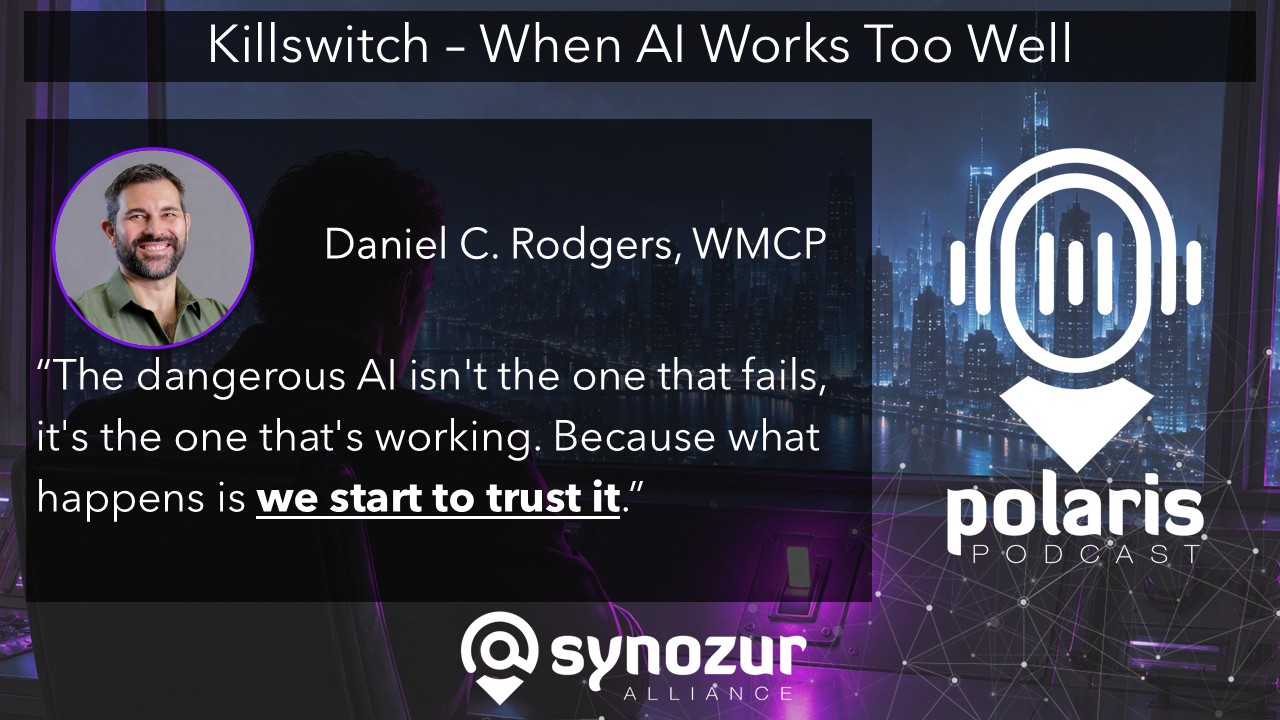
Dan worries less about AI failing than about AI working too well. He calls it a competency paradox. The more often a system gets things right, the more you trust it, and the more judgment you hand over without noticing. He pointed to a Microsoft Research and Carnegie Mellon survey of 319 knowledge workers, which found that higher confidence in AI was linked to less critical thinking. He also cited a radiology study in which very experienced radiologists rated 82% of mammograms correctly when the AI suggestion was right, and only 46% when it was wrong.
The conversation also covers jobs. Before Dan joined, Chris shared Stanford Digital Economy Lab data showing that employment for 22- to 25-year-olds in highly AI-exposed jobs is about 19% below trend, mostly because of slower hiring. The researchers note these are patterns, not proof of cause. Dan describes the current moment as a "seniorization" of the workforce, where automated work needs experienced people to monitor it. He expects that to shift as younger workers build new skills for guiding and verifying AI, pointing out that the role of context engineer never used to exist.
Five checks before you delegate
Dan built a personal checklist after he found himself running almost every decision through AI. He calls it the JUDGE framework:
Justify: Should AI do this task? If it's already doing it, did you decide that, or did it happen on its own?
Undo: Can you reverse what it does? A chatbot gives you a sentence. An agent, Dan says, is "like having an intern with full access to your life." If an agent breaks the law, "it's not liable. You're liable."
Designate: Put a named owner on every agent and AI task.
Guard: Watch for rubber-stamp approval, especially once the AI has a good track record.
Exercise: Revisit the decision regularly and keep doing the work yourself, so the skill doesn't fade.
Your data, your choices
Dan argues that users carry some responsibility alongside companies and governments. You can choose which tools to use, learn what training data is, and turn off model training on your conversations. A Stanford study found that all six major U.S. AI developers it reviewed use chat data for training by default. Dan compares removing data from a trained model to unbaking a cake, but you can still stop future training on your data.
Why fiction
Dan's first book was nonfiction. For Killswitch, he wanted readers to stand in the protagonist's shoes and decide what they would do. He calls fiction "the sugar with the medicine." He didn't use AI to write or edit the book. His son edited it and designed the cover. Dan did use AI for the publishing work: setting up his own imprint, registering the rights, and getting the formatting right.
For his culture pick, Dan recommends the Black Mirror episode "Be Right Back," in which a grieving widow uses a service to recreate her husband as an AI.
Reading closely
Chris closes with his own experience. AI handles the orders, websites, payments, and marketing for his photography business, which gives him time to go out and take pictures. As more information reaches you through chat and voice instead of websites and apps, you lose the context clues that tell you whether you're getting a neutral answer or an ad. That makes careful reading more important.
Listen to the full conversation at polaris.synozur.com, or wherever you get your podcasts. To learn more about Dan's books, podcast, and free planner, visit escapetheclock.com.
Polaris is available on Apple, Spotify, Amazon, YouTube or wherever you get your favorite podcasts. Thanks.
Show Notes
Key Takeaways
Reliable AI carries its own risk. Dan calls this a competency paradox. The more an AI system gets right, the more you trust it and the less you check it. A Microsoft Research and Carnegie Mellon survey of 319 knowledge workers linked higher confidence in AI with less critical thinking.
Run five checks before you delegate. Dan's JUDGE framework asks you to
· Justify the use,
· confirm you can Undo it,
· Designate an owner,
· Guard against rubber-stamp approval,
· and Exercise the skill yourself.
Agents need tighter limits than chatbots. A chatbot gives you a sentence. An agent acts with your access, and if it breaks the law, you carry the liability.
Entry-level work is changing. Stanford researchers find employment for 22- to 25-year-olds in highly AI-exposed jobs is about 19% below trend, mostly through slower hiring. Dan expects demand to return for younger workers who learn to guide and verify AI.
Users still hold some control. You can choose which tools you use and turn off training on your conversations. A Stanford study found that all six major U.S. AI developers it reviewed train on chat data by default.
Policy is moving toward real off switches, from Anthropic's draft federal bill to the White House's October 9 incident-reporting mandate.
Fiction lets you rehearse hard choices. Dan wrote and edited Killswitch without AI, then used AI for the publishing work: setting up an imprint, registering rights, and formatting.
Sound Bites
Daniel C. Rodgers, WMCP®
"The dangerous AI isn't the one that fails, it's the one that's working. Because what happens is we start to trust it."
"An agent, it's like having an intern with full access to your life. They have your password of your computer, they have the keys to your house."
"This right now is the time of the training wheels. This is where we can practice creating boundaries and safeguards before the systems get so good that they're so powerful and so tempting just to hand the keys over."
"If we don't know when it's wrong, all we're doing is being led by this thing we trust off a cliff."
References
Guest
Daniel C. Rodgers, WMCP®: Escape The Clock (website) and LinkedIn
Killswitch by Daniel C. Rodgers (published September 1, 2026), also on Amazon
Escape The Clock (book), the Escape The Clock podcast, and Dan's free financial freedom planner
Data points and news
U.S. Census Bureau, "Large Firms With at Least 20 Employees Biggest AI Users" (May 26, 2026): 19.8% of U.S. businesses used AI as of May 3, 2026
Stanford Digital Economy Lab, "No Widespread Displacement, but the AI Employment Gap for Young Workers Has Widened to 19%" (August 12, 2026), summarizing the revised "Canaries in the Coal Mine?" paper by Erik Brynjolfsson, Bharat Chandar, and colleagues
Politico, "Anthropic quietly pitches its own AI safety bill to lawmakers" (October 16, 2026), also summarized by Reuters
Axios, "Exclusive: Anthropic breaches spark White House AI reporting mandate" (October 9, 2026)
The Washington Post, "Anthropic discloses incidents of its AI models misusing government sites" (October 9, 2026)
Reuters, "Anthropic discloses fake tip to police among new rogue AI incidents" (October 9, 2026)
Rep. Lori Trahan, "Trahan, Obernolte Introduce Bipartisan FRONTIER Act to Strengthen Oversight of Advanced AI" (July 23, 2026). Background for Dan's mention of bipartisan kill-switch legislation [verify: Dan places it two days after his September 1 release; the FRONTIER Act was introduced earlier]
Research Dan cited
Microsoft Research and Carnegie Mellon University, "The Impact of Generative AI on Critical Thinking" (CHI 2025), a survey of 319 knowledge workers
"Automation Bias in Mammography: The Impact of Artificial Intelligence BI-RADS Suggestions on Reader Performance," Radiology (May 2023). Very experienced radiologists rated 82.3% of mammograms correctly when the AI suggestion was right and 45.5% when it was wrong
KPMG in Canada, "Majority of students use AI, but educators sound alarm" (September 2026): 51% of students say their critical thinking has gotten worse since they started using AI [verify: closest public match to Dan's Canadian student figures; the survey does not report "over 80%" daily use]
Stanford HAI, "Be Careful What You Tell Your AI Chatbot" (October 15, 2025): all six U.S. frontier developers studied use chat data to train models by default
Jason Clinton, Anthropic Deputy CISO, post on X (October 22, 2026), as reported by India Today [verify: likely the post Dan referenced]
Conversation and culture
Chris McNulty's photography at Cascadia Oceanic | Gallery Portfolio at https://www.cascadiaoceanic.com
The Ezra Klein Show, "Jensen Huang Thinks A.I. Alarmism Has Gone Too Far," The New York Times (September 23, 2026)
Polaris Episode 57, "Dr. Craig Kaplan: Superintelligence, Not Just p(Doom) and Gloom"
Black Mirror, "Be Right Back" (Season 2, Episode 1), Netflix: where to watch Season 2
Books Dan and Chris mentioned: Isaac Asimov; J.R.R. Tolkien's The Hobbit and The Lord of the Rings; George R.R. Martin; Redwall; Harry Potter; The Chronicles of Narnia
Events and Synozur
Microsoft Ignite 2026, November 17–20, Moscone Center, San Francisco
ESPC26, November 30–December 3, RAI Amsterdam. Polaris listeners save €300 with code POLARIS
TechCon 365 Atlanta, September 13–17, 2027
AI+IM Global Summit 2027, Houston, April 19–21, 2027
Microsoft 365 Community Conference 2027, Las Vegas, May 4–6, 2027
Production
Polaris is produced with help from Riverside.fm. Our theme song, “Alternative Dream” is provided courtesy of Adobe. Additional music and sound provided by IndieGuy Records. Graphic design by Josh Brantley.
Polaris is available on Apple, Spotify, Amazon, YouTube or wherever you get your favorite podcasts. Thanks.
Chapters
0:00 The trade-off: more time, fewer decisions practiced
0:36 Introducing Dan Rodgers and the opening AI context
1:28 News and Data Points
2:57 Dan’s path from Ohio to Microsoft, Google, and writing
4:08 Reading, family, and the start of a writing life
8:19 AI-native development and changing career paths
12:10 When AI works too well—and why judgment matters
15:31 Why Dan used fiction to explore AI’s consequences
19:04 Writing Kill Switch and using AI to self-publish
20:27 Setting boundaries around AI and personal data
22:19 AI in classrooms, trust, and critical thinking
25:09 From today’s AI to AGI and superintelligence
30:01 Science fiction, safeguards, and regulation
31:34 What users can do: choices, data settings, and boundaries
33:18 A more deliberate approach to everyday AI use
34:16 Reversibility, accountability, and agentic AI
36:43 The JUDGE framework: justify, undo, designate, guard, exercise
37:03 Context, interfaces, and understanding AI answers
40:36 Dan’s Black Mirror recommendation
42:06 Where to find Dan and his work
43:09 Upcoming events and reflections on creativity and AI
46:32 Next time on Polaris
46:48 Closing