Open LinkedIn on almost any morning and you'll see the same picture: a badge resting on a closed laptop, a quiet goodbye to a job that AI — or the spending around it — made redundant. The reflex is to move fast. Fix the résumé, fire off applications, land the next thing before the severance runs out. In the latest Polaris episode, career strategist Keith Anderson makes a different case: the fastest way forward might be to slow down.
The backdrop is real. In its fiscal 2026 filing, Oracle became the first company of its scale to name AI in an SEC filing as a cause of workforce reduction, with headcount dropping about 13%. Across the sector, 2026 tech layoffs have passed 225,000 — more than all of last year. Yet the evidence that AI is actually doing the work of the people let go is thin; companies are pouring money into AI and trimming costs elsewhere.
The pressure lands hardest at the start of a career. The Stanford Digital Economy Lab's "Canaries in the Coal Mine?" study finds employment for 22-to-25-year-olds in AI-exposed jobs running about 19% below where you'd expect. A counter-study argues there's no evidence of widespread displacement. What isn't in dispute: recent-graduate unemployment near 5.6% and underemployment near 42%. Automation is moving fast; the human core is moving slower.
That gap is where Keith works. A former schoolteacher who spent about 15 years in tech and consulting before founding Work Redesigned, he brings a teacher's empathy to the question underneath the headlines: when the machine can do the task, what's left that's yours?
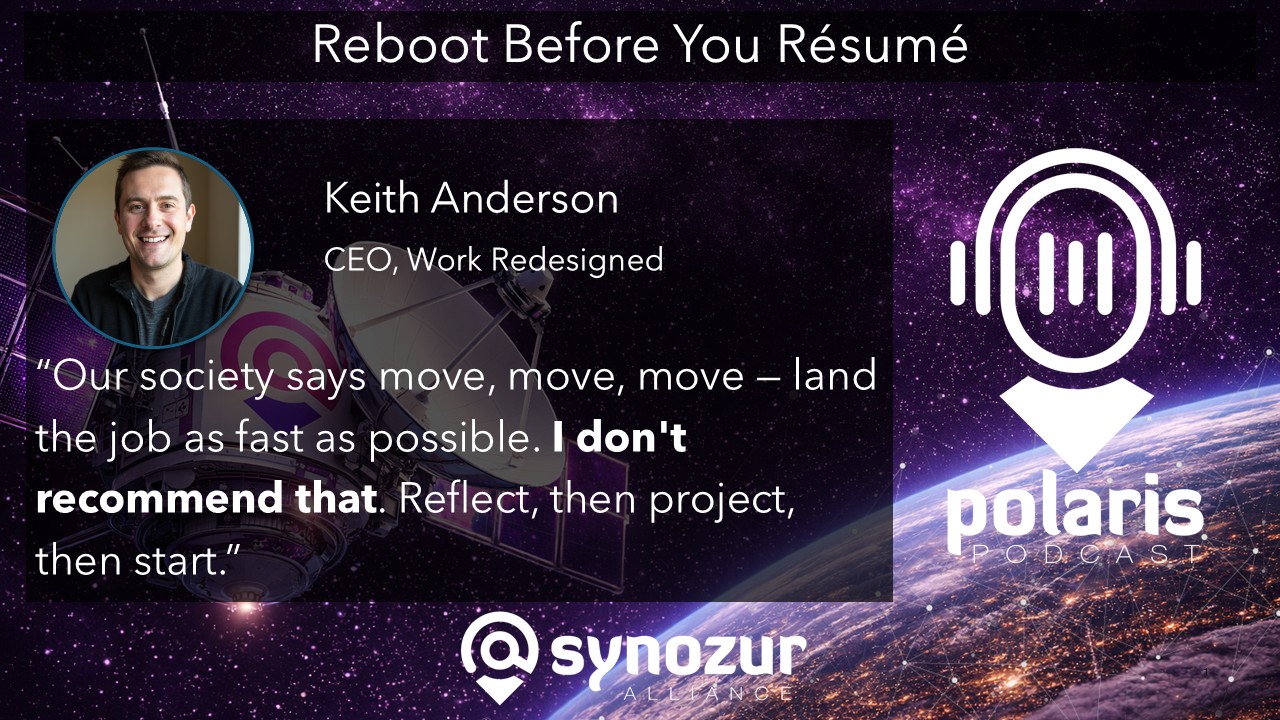
His answer starts with reflection. When someone comes to him after a layoff, he doesn't open the résumé. He asks what energized them and what drained them, then works toward what fits next. "Reflect, then project, then start," he says. Skip that, and you carry the same baggage into the next job, and the next.
Keith is also candid about skills. Some abilities that were prized before AI — like drawing connections across large amounts of content — are being deprioritized because AI does them well. The skills that hold their value are human: discernment, and the ability to problem-solve when things don't go as expected. The real question, he says, is your relationship with the tools: "Are you blindly copying it and saying that it's your work, or are you a collaborator with it?"
That's also reshaping how people get hired. As recruiters grow wary of AI-generated applications and put their walls up, Keith points job seekers back to something surprisingly old-fashioned. "You can't fake face to face," he says — and a phone call, paper mail, or a real conversation can now carry you further than another cold message. His book, The 30-Day Career Reboot, is built around this idea. It isn't a promise you'll land a role in 30 days; it's career discovery — understanding your own map before you forge into new terrain.
Chris and Keith close on a hopeful note. One of Keith's clients, a burned-out software engineer, rebooted into a senior director of medical-device sales — a path he never saw coming. "You might be a remix of what you've done before," Keith says. Chris shares his own version: leaning back into landscape photography after Microsoft, now run start-to-finish with AI, yet anchored by a film photo he shot in college that remains one of his most popular pieces.
Whether you're between jobs, rethinking your role inside a big company, or just trying to stay relevant, this conversation is a practical, human guide to what comes next. Listen at polaris.synozur.com.
Polaris is available on Apple, Spotify, Amazon, YouTube or wherever you get your favorite podcasts. Thanks.
Show Notes
Takeaways
Reflect before you rush. Keith's sequence is "reflect, then project, then start" — clarity on who you are has to come before the job search, or you carry the same baggage into the next role.
Know which of your skills AI is quietly deprioritizing — like drawing connections across large amounts of content — and which human skills are rising in value: discernment, judgment, and problem-solving when things don't go as planned.
"Solopreneur within a company" is a mindset, not a job title. Own outcomes rather than headcount, use AI as your team, and build a routine that grounds you when the corporate scaffolding falls away.
Analog cuts through the noise. As recruiters put up walls against AI-generated applications, a phone call, paper mail, or a real conversation can move you further than another cold LinkedIn message.
Trust is the new currency. Instead of policing résumés against LinkedIn to catch AI use, focus on genuine person-to-person connection — the real signal of who you want to work with.
The 30-Day Reboot is career discovery, not a 30-day job guarantee. It's built to help you understand your own map before you forge into unfamiliar terrain.
The data is real but nuanced. The headlines say "AI cuts," yet the evidence that AI is doing the work of the people let go is thin — a gap worth understanding before you panic.
Sound bites
Keith Anderson
· "You might be a remix of what you've done before."
"When you're a solopreneur, you are as big as you get — and you need to define what that is."
"Are you blindly copying it and saying it's your work, or are you a collaborator with it?"
"Recruiters are being inundated by robots — they can't tell the difference between what's real and what's not."
"Your résumé and your LinkedIn are basically pieces of paper — one slice in time. There's so much more to who we are than that."
"Our society says move, move, move — land the job as fast as possible. I don't recommend that. Reflect, then project, then start."
References
· Keith Anderson is the founder and CEO of Work Redesigned, and you can reach him on LinkedIn. He is the author of The 30-Day Career Reboot. Before founding Work Redesigned, he held roles at Google, Meta, and DoorDash, which he referenced in the conversation.
· Oracle became the first company of its scale to name AI in an SEC filing as a cause of workforce reduction, with headcount falling roughly 13% — from about 162,000 to 141,000 — as reported by Crunchbase News and Tech Times, which also tracks 2026 tech layoffs surpassing 225,000.
· The claim that early-career workers are being hit hardest comes from the Stanford Digital Economy Lab's "Canaries in the Coal Mine?" study, which finds employment for 22-to-25-year-olds in AI-exposed jobs about 19% below expectation.
· A counter-view — that there is "no evidence of significant, widespread displacement" — and the figures on recent-graduate unemployment (near 5.6%) and underemployment (near 42%) are covered by Ars Technica and this IntuitionLabs analysis of the entry-level hiring data.
· Also mentioned: Chris's landscape photography business at chrismcnulty.net.
Events
· North American Collaboration Summit | October 4-6 (Branson, MO) collabsummit.org
· CollabDays New England | October 16 (Burlington, MA) collabdaysne.org
· Microsoft Ignite — November 17-20 (San Francisco, CA) ignite.microsoft.com
· ESPC26 | November 30-December 3 ( Amsterdam ) espc.tech/conference/espc-2026/
Production
Polaris is produced with help from Riverside.fm. Our theme song, “Alternative Dream” is provided courtesy of Adobe. Additional music and sound provided by IndieGuy Records. Graphic design by Josh Brantley.
Chapters
00:00 Introduction to AI's impact on the workforce
02:23 AI named as a cause of workforce reduction in SEC filings
03:19 The shrinking entry-level job market and its implications
04:00 Meet Keith Anderson: His background and journey
05:12 Keith's perspective on the core of human identity and change
08:52 Lessons from teaching and their application in career coaching
11:22 Advice for those facing layoffs and restructuring
13:22 The influence of AI on resume and LinkedIn authenticity
16:14 How HR is using AI and the candidate experience
19:04 Strategies for standing out in a competitive job market
20:11 Realistic expectations during career transitions
24:15 The role of AI in personal productivity and human connection
31:58 The 30-day career reboot: Process and success stories
37:47 How businesses can leverage AI and workforce redesign
38:54 The value of improv and creativity in professional growth
40:28 Staying connected and the importance of human interaction
42:50 Balancing AI tools with human touch in creative work
43:23 Upcoming episodes and closing remarks