I recently sat down with Jordan Uytterhagen, a long-time colleague and the CEO of Cadence Solutions, for an episode of our Polaris podcast. We dove into one of the big challenges facing many companies today: getting content out of legacy systems and into modern cloud platforms. Why does this matter so much now? In a word, AI.
Everyone’s excited about the promise of AI in business, but if your information is stuck in outdated file shares or legacy ECM software, those shiny new AI tools won’t do much for you. As Jordan succinctly put it during our chat, true AI-readiness begins with modernizing the platforms that feed into AI. In other words, you need to free your data before you can really fuel the future.
Here are some of our highlights:
Modernizing for AI-Readiness: Organizations are eager to leverage AI, but if their information is trapped in "Flintstones-era" legacy systems, even the most advanced "Jetsons-level" tools can't help. Migrating data to the cloud is critical to unlock AI potential.
Under-utilized Cloud Investments: Many businesses pay for cloud services like Microsoft 365 but keep using outdated systems. Once they finally migrate, they can retire costly legacy platforms and access powerful new features.
Immediate Wins Before AI: While AI is a major motivator, teams often celebrate simpler benefits after migration, such as:
Easy document search and strong audit trails
Enhanced compliance and security for legal teams
Co-authoring capabilities that eliminate the chaos of email attachments named things like Draft_v7_final_FINAL.docx or final_final_v2
Balancing Organization Styles: Some people are "filers," loving neat folders, while others are "pilers," dumping everything in one place and relying on search. Successful migrations provide a simple structure for both: shallow folders and a few metadata tags, while letting AI help make sense of less-organized piles.
Migrating Isn’t Just Copy-Paste: Legacy systems often have built-in logic—like retention policies, workflows, and integrations—that need careful handling. Migration projects should start with "discovery" to map what's worth moving, perhaps phasing the transition by department or content type.
Know Your Source System: The biggest challenges often come from the quirks of the old system, not the new. It's crucial to partner with experts who have deep experience with the legacy platform - whether that's OpenText, FileNet, Lotus Notes, or other tenured platforms of the business world.
Governance, Timing, and Risk: Migration success depends on clear policies (like deciding if you really need 42 versions of a final_final document from 2014), thoughtful timing (using quiet periods like holiday weekends), and thorough user communication and testing.
AI-Powered Migrations: The next wave is using AI for smarter migrations—pre-analyzing data before the move to identify the “crown jewels” and deprioritize (or leave behind) redundant, outdated, or trivial files (ROT). AI can spot sensitive info for special handling, making the new system cleaner and more useful than ever.
Closing Thoughts
Towards the end of our conversation, I shifted gears and asked Jordan a fun question I pose to all my guests: What non-work thing have you enjoyed lately that resonates with you? It turns out Jordan has been reading Shoe Dog, Phil Knight’s memoir about building Nike. As the founder of a boutique firm, he really connected with the rollercoaster of creating something from scratch – the scrappiness, the setbacks, the triumphs. We ended up geeking out about business movies and books: The Founder (the McDonald’s story), the recent movie Air (about Nike courting Michael Jordan), and I recommended the book Too Big To Fail to him since he loved the film The Big Short. It was a fun, human end to a strategic tech discussion. Whether we’re talking about data migration or a shoe company’s rise, at the core it’s about people, decisions, and navigating change.
(Listen to the full Polaris episode with Jordan Uytterhagen here, or find it on your favorite podcast platform. And as always, I’d love to hear your thoughts – feel free to reach out or leave a comment!)
Polaris is available on Apple, Spotify, Amazon, YouTube or wherever you get your favorite podcasts. Thanks.
Show Notes
Notable Quotes (Jordan Uytterhagen)
“You go from Jetsons technology at home to Flintstones technology at work.”
“Co-authoring is a huge change management win without really needing to do anything.”
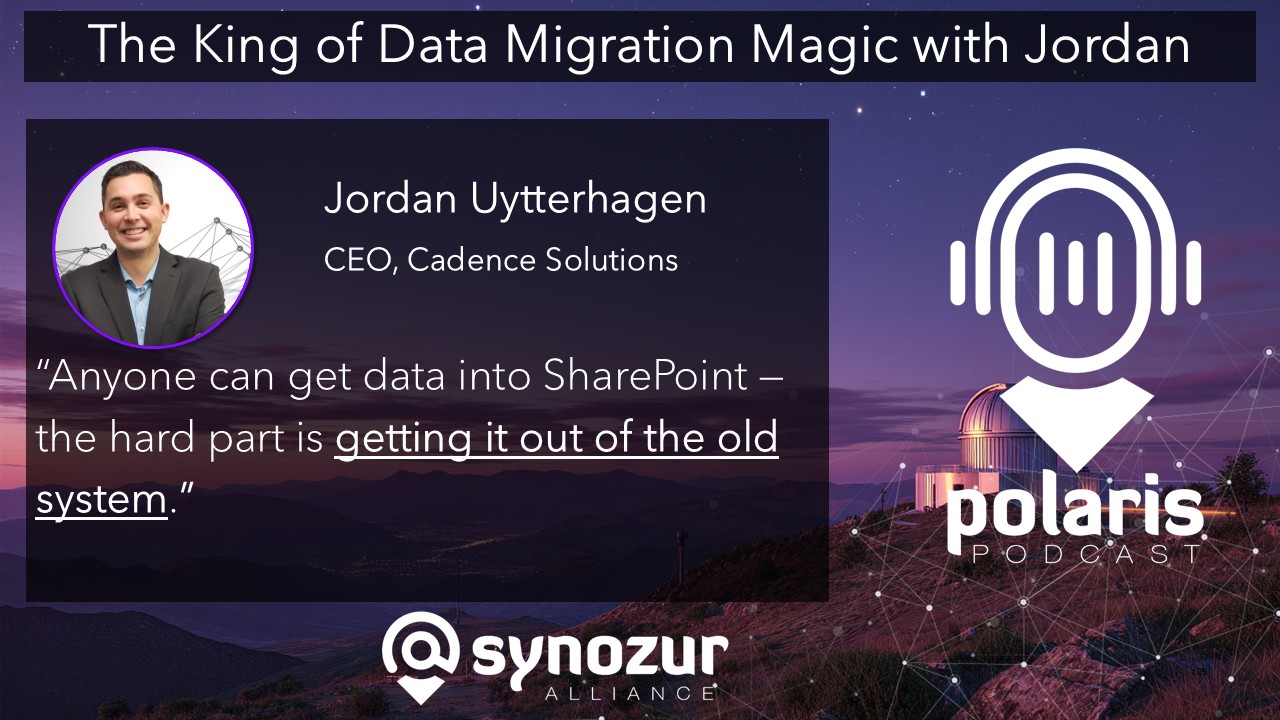
“Anyone can get data into SharePoint—the hard part is getting it out of the old system.”
“There are filers and there are pilers, and you can’t make one into the other.”
References
Industry
Forbes – Reference about modernizing legacy data platforms for AI readiness.
CIO Magazine – Article on consolidating outdated systems onto modern platforms to cut costs and complexity.
Gartner – Emphasizing that careful planning and risk management in data migrations leads to more successful outcomes.
OpenText – An enterprise content management software suite often used for document and records management.
Kofax – A software company specializing in document capture, OCR, and automation solutions for digitizing content.
Guest
Jordan Uytterhagen - LinkedIn
Cadence Solutions – The boutique firm founded by Jordan Uytterhagen, focused on data migration and information governance (Microsoft 365 specialist).
Pop culture
The Jetsons – A 1960s animated sitcom set in a futuristic world of advanced technology (shorthand for “modern tech”).
The Flintstones – A 1960s animated sitcom about a Stone Age family (shorthand for “outdated tech”). It was created to be a primetime Stone Age cartoon based on The Honeymooners with Jackie Gleason and Art Carney.
Shoe Dog – A memoir by Nike co-founder Phil Knight, recounting the scrappy early days and growth of Nike.
The Founder – A 2016 biographical film starring Michael Keaton about Ray Kroc and the expansion of the McDonald’s franchise.
Air (2023) – A 2023 film dramatizing Nike’s pursuit of a young Michael Jordan and the creation of the Air Jordan sneaker line starring Matt Damon and Ben Affleck.
Too Big to Fail - A 2009 book by Andrew Ross Sorkin (and later an HBO film) detailing the 2008 financial crisis and the collapse of Wall Street institutions.
The Big Short – A 2015 film (based on Michael Lewis’s book) that portrays a few investors who bet against the 2008 housing bubble and profited from the financial crisis.
American Greed – A CNBC true-crime documentary series that profiles cases of corporate fraud and white-collar crime.
Moneyball – A 2011 film (based on a book) about the Oakland A’s baseball team using data analytics to build a competitive roster on a budget, with Brad Pitt, Chris Pratt, and Jonah Hill.
War Dogs – A 2016 film based on the true story of two young men who became unlikely arms dealers for the U.S. government, again with Jonah Hill and Miles Teller.
Events
M365 Community Days NYC | July 25, 2025 at Microsoft NYC in Times Square
Seattle Tech Week | July 28 - August 1, Seattle WA
TechCon 365 Atlanta | August 11-15 at the Georgia World Congress Center.
FY26 Forward - Microsoft Partner Success Strategies - August 26
North American Collaboration Summit | September 7-9 Branson, MO
TribalNet Conference | September 14-18, 2025, Reno Nevada
London Tech Leaders’ Summit | October 7-8, 2025 London UK
Experts Live | October 10, 2025 at Microsoft NYC in Times Square
Vancouver AI Summit | October 20, 2025 Vancouver BC
Takeaways
Modernize for AI: True AI readiness begins with a solid data foundation. Jordan explains that moving content from old systems to modern cloud platforms is key before using advanced AI tools. Without accessible data, even the best AI models can’t provide value, so modernization is essential.
Use Your Cloud Investments: Many organizations already pay for Microsoft 365 yet don’t fully use it. Migrating legacy data unlocks built-in features and cuts costs by retiring outdated systems. Jordan shares examples where clients used their E5 licenses more effectively after migration, boosting ROI on existing software.
Immediate Wins (Beyond AI): Migration brings quick benefits beyond future AI. For instance, e-discovery and audit trails improve instantly when data is consolidated, pleasing compliance teams. Co-authoring in SharePoint and OneDrive also boosts collaboration, especially for new hires used to modern tools, helping drive change.
Filers vs. Pilers – Keep Some Structure: People organize in different ways—filers prefer folders, pilers use search. Jordan recommends a light structure with basic folders and metadata for filers, so everyone has a place for their content. This approach avoids overcomplication and supports both search-driven users and governance.
Migration Is More Than Moving Files: Migration involves more than just transferring files; legacy systems often have retention policies, workflows, or integrations. These elements need to be rebuilt in the new system. Jordan stresses that detailed planning is crucial, including what to move first and how to manage processes post-migration.
Choose Partners with Source Expertise: Jordan’s key point is that extracting data from old systems is the hardest part. Pick migration partners familiar with your legacy platform to avoid missing data or complications. His team even built specialized tools for common legacy systems, highlighting the value of source expertise.
Plan, Govern, and Manage Risk: Success means balancing speed with caution. Jordan advises migrating by department or priority, freezing content during cut-over, and scheduling transitions during off-peak times. It's okay to leave behind unnecessary data. Careful planning prevents loss or disruption and ensures the migration finishes on time.
Production
Polaris is produced with the help of Riverside.fm. Our theme song, “Alternative Dream” is provided courtesy of Adobe. Additional music and sound provided by IndieGuy Records. Graphic design by Josh Brantley.
Polaris is available on Apple, Spotify, Amazon, YouTube or wherever you get your favorite podcasts. Thanks.
Chapters
00:00 Introductions
01:09 Terms and Data Points
01:59 Welcome to Jordan Uytterhagen
04:31 The Role of AI in Data Migration
07:26 Understanding Microsoft 365 Benefits
10:20 Migration Strategies and Challenges
12:58 Information Architecture vs. AI
15:49 The Future of Data Migration
17:31 Client Experiences and Lessons Learned
19:48 Tools and Services for Migration
22:56 The Importance of Understanding Legacy Systems
29:32 Cultural Insights and Recommendations
32:45 Upcoming Tech Events Overview
34:35 Wrap-Up and Guest Insights