I recently sat down with Andrew Connell — a 22-year Microsoft MVP and founder of https://www.voitanos.io — for our 50th episode of Polaris. Our topic: vibe coding, the practice of telling an AI what you want and watching it write the software. What we found is that the conversation goes far beyond a buzzword. It touches strategy, talent, quality, and the very definition of what a developer does.
Microsoft's AI Direction
Andrew didn't hold back. "Microsoft is flailing a good bit," he told me. "They seem to be reacting to what other people are doing, and there's no real cohesive story". His frustration centers on what he calls "shipping the org chart" — multiple product teams building disconnected Copilot experiences that confuse customers and developers alike.
Andrew emphasized that Microsoft's moat is enterprise data — organizations have invested deeply in Microsoft 365. But distribution alone doesn't guarantee adoption when rivals deliver a more consistent experience. If you're deploying Copilot in your organization, this is worth knowing: your teams may need help understanding which Copilot does what, and when other tools might serve them better.
Vibe Coding vs. Agentic Engineering
When Andrej Karpathy coined "vibe coding" in February 2025 — describing a practice where you "fully give in to the vibes… and forget that the code even exists" — Andrew initially hated the idea. "I'll be honest, I got a little defensive: you're coming on my turf!".
But his thinking evolved. He now distinguishes between naive vibe coding (generate-and-ship without review) and what he calls agentic engineering: using AI agents to accelerate development while maintaining human oversight at every stage.
Here's a practical example. Andrew built a Chrome extension using AI to automate tedious chapter-tagging and quiz-generation in his course platform. A task that used to take him two days now takes about ten minutes. Did he review the code? Eventually. But the blast radius was limited — the only person affected was him. For internal tools and personal productivity, vibe coding is a sensible accelerator. For production enterprise software? You need the discipline of agentic engineering.
What This Means for Your Teams
If you're a CTO or business leader, here's what you should take away.
Invest in a Center of Excellence. Andrew recommends a core group that deeply understands AI development tools — "like a carpenter who knows which tool works for which job" — to guide the broader organization.
Don't stop hiring junior talent. IBM's decision to triple entry-level hires reflects a reality Andrew underscores: cutting juniors now creates a leadership vacuum in three to five years. Rewrite roles to embed AI fluency, not to eliminate people.
Treat code review as your primary quality gate. With nearly 30% of senior developers reporting that editing AI output erases most of their time savings, code review is no longer the end of the pipeline — it's the critical center of it.
Match the tool to the task. Use vibe coding for prototypes, demos, and internal productivity tools. Apply agentic engineering discipline to anything customer-facing, security-sensitive, or production-bound.
Looking Up
We closed the episode with Andrew sharing what's been inspiring him outside of tech: the NASA Artemis II mission, which launched April 1, 2026, and returned to Earth on April 10 after a nearly 10-day lunar flyby — the first crewed trip to the Moon in more than 50 years. Andrew watched the launch from 142 miles away in Florida and said the whole neighborhood came out to watch. His daughter is now exploring STEM paths inspired by the mission. Sometimes the best reason to keep building is to keep looking up. [nasa.gov]

Earthrise, Artemis II, 2026
Catch the full episode at https://polaris.synozur.com.
Polaris is available on Apple, Spotify, Amazon, YouTube or wherever you get your favorite podcasts. Thanks.
Show Notes
Takeaways
Vibe Coding Has Gone Mainstream. AI-assisted coding is no longer experimental. A GitHub survey found 92% of U.S. developers use AI coding tools at work, and Gartner projected that 60% of new code would be AI-generated by 2026. The global market for AI code-generation platforms has reached $4.7 billion, with projections of $12.3 billion by 2027. Collins English Dictionary cemented the trend by naming "vibe coding" its 2025 Word of the Year. [secondtalent.com] [strayspark.studio] [ndtv.com]
Speed Gains Come with a Comprehension Tax. A January 2026 Anthropic randomized controlled trial of 52 junior engineers found that developers using AI code assistants scored 17% lower on comprehension tests than those coding manually — averaging 50% versus 67% on quizzes — with the largest gap appearing in debugging questions. Productivity gains did not reach statistical significance. This confirms what Andrew warns: rapid output without understanding creates fragile systems. [infoq.com]
Microsoft's Copilot Strategy Is Fragmented. Andrew contends that Microsoft is "flailing" and "shipping the org chart," with multiple disconnected Copilot products that confuse customers. A Recon Analytics study of more than 150,000 respondents (July 2025–January 2026) found Microsoft Copilot's share as paid users' primary AI tool fell from 18.8% to 11.5% — a 39% contraction — while Google Gemini climbed from 12.8% to 15.7% and ChatGPT held roughly 55.2%. When all three platforms were available, only 8% of workers chose Copilot versus 70% for ChatGPT and 18% for Gemini.[reconanalytics.com]
"Agentic Engineering" Is the Mature Alternative to Naive Vibe Coding. Andrew initially "hated" the term vibe coding but came to distinguish between undisciplined prompt-and-ship and a professional practice he calls agentic engineering, a term he credits to technologist Simon Willison. In agentic engineering, the developer still reviews AI output, plans architectures, and catches errors — using AI as a force-multiplier for experienced judgment, not a replacement for it.
Developers Are Becoming AI Orchestrators. Chris and Andrew agree that the most effective AI-era developers act like development managers: delegating tasks to specialized AI agents (ideation, UX, debugging, documentation) and then integrating and verifying results. Andrew recommends organizations build an internal Center of Excellence — a handful of people who deeply understand AI tooling and can guide the broader team.
Entry-Level Talent Still Matters — IBM Proved It. Despite predictions that AI would replace junior roles, IBM announced in February 2026 that it is tripling its entry-level hiring, including for software developers. IBM CHRO Nickle LaMoreaux stated: "We are tripling our entry-level hiring, and yes, that is for software developers and all these jobs we're being told AI can do". IBM's rationale: cutting junior talent creates future shortages of mid-level managers and senior experts, and outside hires cost more and adapt more slowly. [finance.yahoo.com]
Quality and Security Demand "Vibe Checks." A December 2025 CodeRabbit analysis found AI co-authored code contained approximately 1.7× more bugs and issues and 1.4× more critical issues than human-written code. Meanwhile, a Fastly survey of 791 professional developers found that nearly 30% of senior developers report that editing and auditing AI output offsets most of their initial time savings. Code review must become a continuous, front-of-cycle discipline, not a final checkbox. [coderabbit.ai]
Quick Quotes
Andrew Connell — Founder, Voitanos
"I think Microsoft is flailing a good bit… They seem to be reacting to what other people are doing, and there's no real cohesive story across all of their M365 Copilot story."
"The one fear that I have with this is what is it going to do to the entry-level jobs? I have a very significant concern."
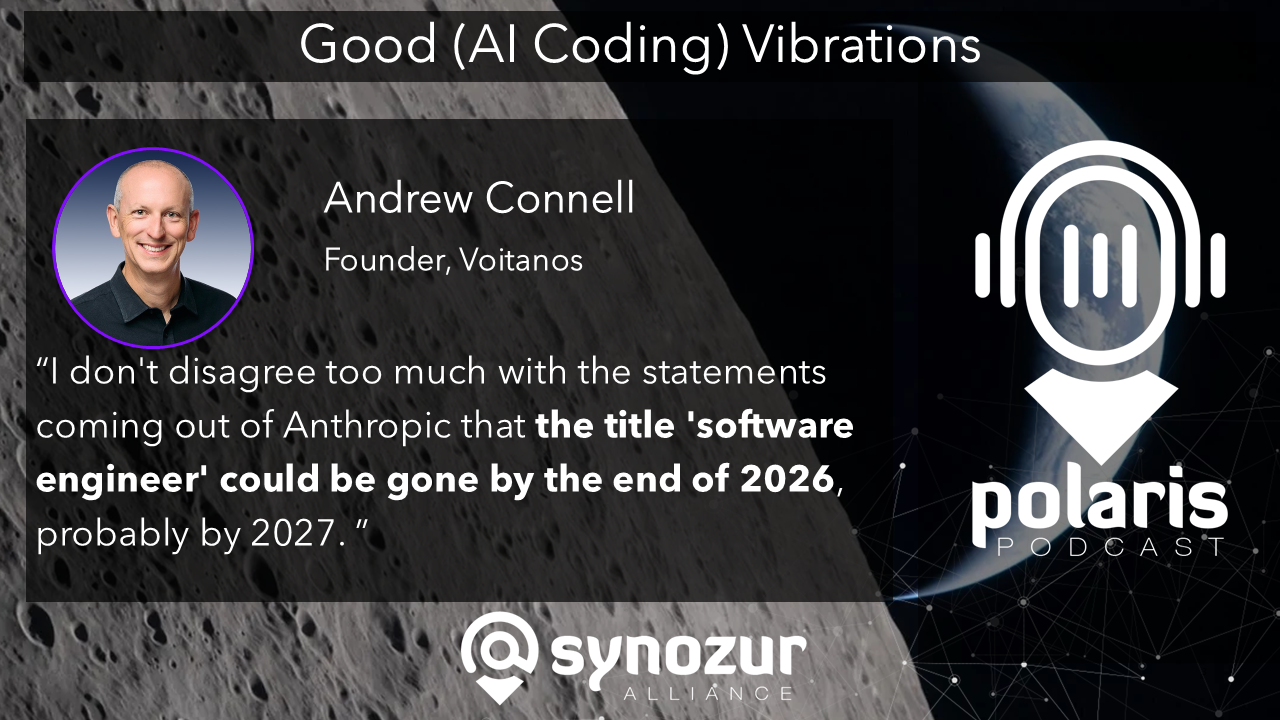
"I don't disagree too much with the statements coming out of the senior people at Anthropic that the title 'software engineer' could be gone by the end of 2026, probably by 2027. As much as I'm using it, I can see that."
"Right now the [Microsoft] plan just feels very reactionary. And that's frustrating to me."
Chris McNulty — Polaris Host
"Client after client we run into — they have a negative impression of Copilot because their belief is that the entirety of Copilot is the free little thing in the corner of the Edge browser."
"What you get is still proportional to the attention you put into it." — Chris McNulty, on AI-generated prototypes versus production-ready software
"Being successful with vibe coding or agentic AI software engineering… helps even more if you've come from a development manager background — I personally use different AI agents for different things."
References
Andrej Karpathy's "Vibe Coding" Coinage (February 2025) — OpenAI co-founder and former head of AI at Tesla, Andrej Karpathy, tweeted about "a new way of programming where you fully give in to the vibes, embrace exponentials, and forget that the code even exists." This sparked a global conversation about AI-driven development. Covered in depth by https://www.coderabbit.ai/blog/a-semantic-history-how-the-term-vibe-coding-went-from-a-tweet-to-prodCodeRabbit: "A Semantic History of Vibe Coding".
Reid Hoffman's LinkedIn Clone Experiment (April 2025) — LinkedIn co-founder Reid Hoffman asked Replit's AI agent to "clone LinkedIn" using a single prompt. The result was a surprisingly functional prototype. Hoffman wrote: "It's a powerful reminder: with the right framing, today's AI tools can turn a single idea into working software." Reported by https://www.ndtv.com/feature/linkedin-co-founder-asked-ai-to-clone-his-company-the-result-surprised-him-8105339NDTV.
Collins English Dictionary — "Vibe Coding" Named 2025 Word of the Year — In November 2025, Collins crowned "vibe coding" as its Word of the Year, beating "clanker," "biohacking," and "aura farming." Managing Director Alex Beecroft said the term "perfectly captures how language is evolving alongside technology." Reported by https://www.ndtv.com/offbeat/collins-dictionary-picks-vibe-coding-as-word-of-the-year-2025-9585221 and https://www.lbc.co.uk/article/vibe-coding-clanker-word-of-the-year-collins-5HjdGQy_2/.
GitHub Developer Survey — 92% of U.S. Developers Using AI Tools — A GitHub survey of 500 U.S.-based developers at companies with 1,000+ employees found 92% were using AI-powered coding tools at work. Reported by https://venturebeat.com/programming-development/92-of-us-based-developers-already-using-ai-powered-coding-tools-at-work-github/VentureBeat and aggregated in https://www.secondtalent.com/resources/vibe-coding-statistics/Second Talent's Vibe Coding Statistics 2026.
· Gartner Forecast — 60% of New Code AI-Generated by 2026 — Gartner predicted that 60% of newly created code would be AI-generated by 2026, a figure now largely confirmed through adoption data. Referenced in https://www.strayspark.studio/blog/60-percent-ai-generated-code-2026-game-development-quality.
· $4.7 Billion Vibe Coding Market — The global market for vibe coding platforms reached $4.7 billion, projected to hit $12.3 billion by 2027. 87% of Fortune 500 companies have adopted at least one vibe coding platform, and 21% of Y Combinator Winter 2025 startups had codebases that were 91% AI-generated. Source: https://www.secondtalent.com/resources/vibe-coding-statistics/.
· Anthropic Randomized Controlled Trial — AI Coding and Skill Formation (January 2026) — Anthropic published a peer-reviewed study of 52 junior engineers showing developers using AI code assistants scored 17% lower on comprehension tests (averaging 50% vs. 67% for manual coders). The AI group finished tasks approximately two minutes faster, but the difference was not statistically significant. Developers who used AI only for conceptual questions scored 65%+, while those who delegated code generation scored below 40%. Published January 29, 2026. Source: https://www.anthropic.comAnthropic; reported by https://www.infoq.com/news/2026/02/ai-coding-skill-formation/.
· Recon Analytics / Wall Street Journal — Copilot vs. ChatGPT vs. Gemini Study (February 2026) — A Recon Analytics study of more than 150,000 U.S. paid AI subscribers (July 2025–January 2026) found Copilot's primary-platform share fell from 18.8% to 11.5% while Gemini rose from 12.8% to 15.7% and ChatGPT held at ~55.2%. Among workers with access to all three, only 8% chose Copilot. Covered by Wall Street Journal reporter Sebastian Herrera. Source: https://www.reconanalytics.com/ai-choice-2026-why-licenses-dont-equal-adoption/.
· IBM Triples Entry-Level Hiring (February 2026) — IBM announced it is tripling entry-level hiring in the U.S., including for software developers. CHRO Nickle LaMoreaux stated companies that "doubled down on entry-level hiring in this environment" will be the most successful in three to five years. IBM plans approximately 12,000 new entry-level positions over 12 months. Originally reported by Fortune; available via https://finance.yahoo.com/news/ibm-tripling-number-gen-z-164332214.html.
· CodeRabbit Analysis — AI vs. Human Code Quality (December 2025) — An analysis of 470 open-source GitHub pull requests found AI co-authored code contained approximately 1.7× more bugs and issues and 1.4× more critical issues than human-written code. A separate Fastly survey of 791 professional developers found nearly 30% of senior devs report editing AI output offsets most of their time savings. Source: https://www.coderabbit.ai/blog/a-semantic-history-how-the-term-vibe-coding-went-from-a-tweet-to-prodCodeRabbit Blog.
· Simon Willison and "Agentic Engineering" — British technologist Simon Willison articulated the distinction between naive vibe coding and agentic engineering, defining the latter as prompt-driven development with full human oversight, review, and testing. Referenced by Andrew Connell in the episode.
· NASA Artemis II Mission (April 2026) — NASA's Artemis II crew launched April 1, 2026, from Kennedy Space Center and splashed down April 10, 2026, completing a nearly 10-day lunar flyby — the first crewed mission to the Moon in over 50 years. The crew traveled 694,481 miles total. Andrew discussed the mission's cultural impact and the 4K Earthrise imagery that resulted. Source: https://www.nasa.gov/news-release/nasa-welcomes-record-setting-artemis-ii-moonfarers-back-to-earth/.
· Guest Links: https://www.voitanos.io | https://www.andrewconnell.com | https://www.linkedin.com/in/andrewconnell
· Podcast: Andrew co-hosts the Code. Deploy. Go Live. podcast with fellow Microsoft MVP Julie Turner.
Events
M365 Community Conference | April 21-23 at the Loews Saphire Falls in Orlando Florida
AI+IM Summit | April 28-30 Hyatt Regency Inner Harbor, Baltimore, MD
TechCon 365 Chicago | June 15-19 McCormack Place I Chicago IL
Production
Polaris is produced with help from Riverside.fm. Our theme song, “Alternative Dream” is provided courtesy of Adobe. Additional music and sound provided by IndieGuy Records. Graphic design by Josh Brantley.
Chapters
00:00 Introduction to Andrew Connell
05:06 Andrew's Journey into SharePoint Development
06:44 Evolution of SharePoint and Microsoft Ecosystem
09:46 Microsoft's AI Challenges and Copilot Insights
19:08 Understanding Vibe Coding and Its Implications
27:00 The Importance of SEO in Content Creation
30:17 Leveraging AI for Content Optimization
35:00 Vibe Coding vs. Agentic Engineering
37:04 The Impact of AI on Software Development
41:40 Cultural Reflections and Personal Insights
44:57 Upcoming Events in 2026
45:45 Innovations in AI-Assisted Software Development