If you lead a team, you probably believe you have a good read on what's really happening inside it. The uncomfortable news, backed by fresh data, is that you almost certainly don't.
Gallup's State of the Global Workplace: 2026 report finds global employee engagement fell to just 20% — its lowest level since 2020 — costing the world economy an estimated $10 trillion in lost productivity. Strikingly, Gallup attributes most of the recent decline to falling engagement among managers themselves. In the United States and Canada, engagement is higher than the global average at 31%, but still near a decade low. The signal leaders most need is the one they're least likely to receive.
That gap is the subject of the latest Polaris episode, where we sit down with Petar Kralev, founder and CEO of Mirror 360. Born in Bulgaria and now based in Austin, Petar studied business at UC Berkeley and worked across finance, technology, and management consulting before setting out to solve a problem he kept seeing everywhere: the human barriers to telling the truth at work.
The expensive problem hiding in plain sight
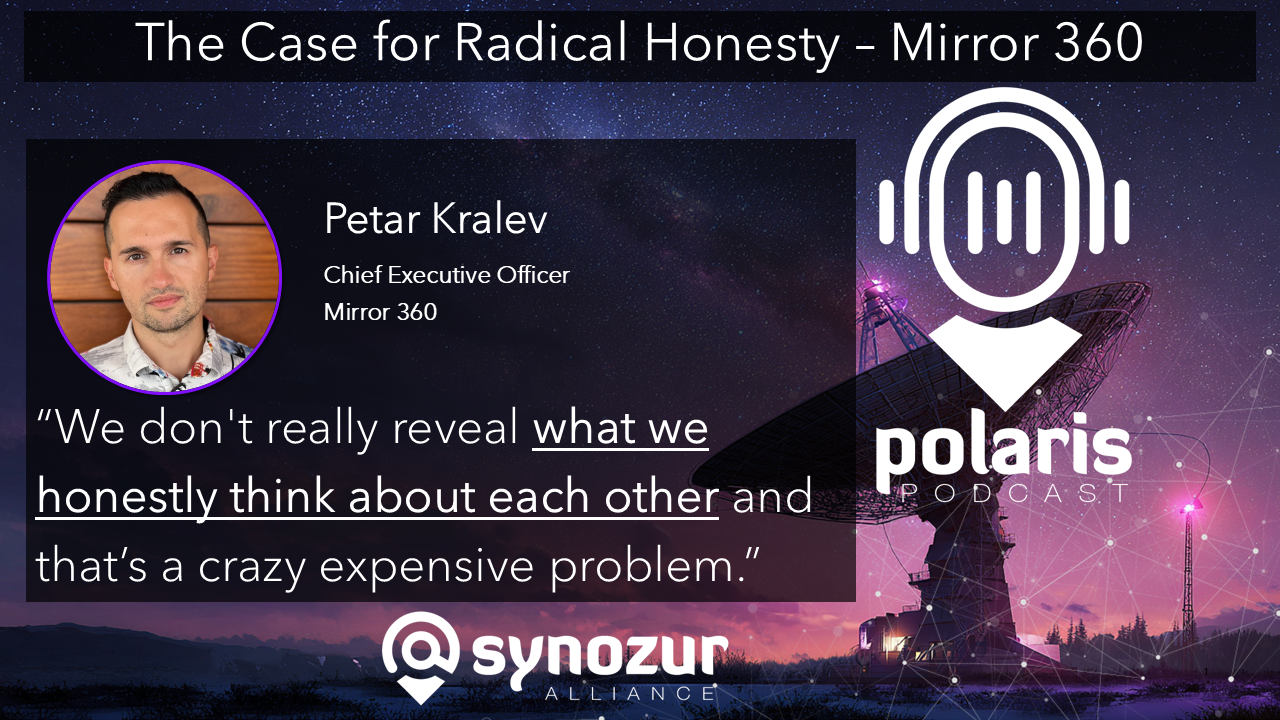
Petar's thesis is blunt: "We don't really easily reveal what we honestly think about each other or about what we see around us in the work context. And that is a crazy, crazy expensive problem." You might assume larger companies, with their formal reviews and bigger HR teams, would solve this naturally. Petar argues the opposite. Those systems exist primarily to document and to reduce legal risk — not to capture how people actually experience their work. As he puts it, that means many organizations "fail to see themselves as they actually are in real time."
The inspiration was personal. Petar describes a coworker who was clearly struggling in a role, while everyone around her could see it and no one would say so. After a Zoom call where she had "lost the room" without realizing it, one question stuck with him: how could she not see herself the way everyone else did?
That question became Mirror 360.
Three things that unlock the truth
Petar breaks the solution into three parts.
First, safety: if a system doesn't guarantee anonymity beyond any doubt, the signal is already polluted.
Second, ease: a reflection takes about 20 seconds, because no one writes paragraphs for a survey they don't have to.
Third, a return on investment: every employee sees their own "mirror image" — how they're actually perceived — while leaders get a clean, aggregated view for real decisions.
The questions are deliberately simple. It starts where a happy-hour conversation would: "How is John working lately?" From there, five standardized reflections measure whether someone communicates well, solves problems, fits on the team, follows high standards, and takes initiative — the same for everyone, "whether you're the CEO of Google or you're laying bricks."
AI filters out harmful or legally risky language and turns messy text into a clean signal, so leaders get reporting "as if a management consultant came in, spent a month or two interviewing people."
There’s a bigger shift: remote and distributed work shattered the old water-cooler signal. A teammate beside you may know more about your work than a manager who sees you on a monthly call. Mirror 360 aims to rebuild that lost insight, digitally and without friction.
Does it work?
Early numbers are encouraging: roughly 90% participation at launch, about nine in ten underperformers stepping up once they can see their blind spots, and one team reaching about 92% top fulfillment after a toxic manager was identified and replaced. Petar's framing lands simply: "It's the difference between turning on the lights or staying in the dark."
The conversation closes on a personal note — Petar's reflection on honesty, drawn partly from Eckhart Tolle's A New Earth, and a question worth carrying into any workplace: "What story do you tell yourself that you take for the truth?"
Mirror 360 is advancing to the Startup World Cup Grand Finale in San Francisco this November.
Polaris is available on Apple, Spotify, Amazon, YouTube or wherever you get your favorite podcasts. Thanks.
Show Notes
Takeaways
Bigger companies often get worse at honest feedback, not better. Formal reviews, large HR teams, and L&D budgets are built mostly to document and reduce legal risk — not to capture how people actually experience work.
Three things have to come together to unlock the truth: safety, ease, and a return on investment. Anonymity must be beyond doubt, input has to take seconds, and people need to see that speaking up actually matters.
One simple opening question carries most of the signal: "How is John working lately?" Mirror 360 then asks five standardized reflections — communicates well, solves problems, fits on the team, follows high standards, and takes initiative.
Anonymity is engineered, not promised. Invitations go out on a randomized weekly cycle and reflections are delivered in batches, so no one can trace a single piece of feedback back to a difficult conversation.
AI is the enabler, not the headline. It filters harmful or legally risky comments and turns raw input into a clean signal — but Mirror 360 frames itself as the infrastructure that makes AI useful for management, not "another AI company."
Remote and distributed work broke the old water-cooler signal. A teammate who sits beside you often knows more about your work than a manager who sees you once a month; Mirror 360 rebuilds that insight digitally.
The results are measurable. Roughly 90% participation at launch, about nine in ten underperformers stepping up once they see their "mirror image," and one team reaching ~92% top fulfillment after a toxic manager was replaced.
Sound bites (Petar Kralev)
"We don't really easily reveal what we honestly think about each other or about what we see around us in the work context. And that is a crazy, crazy expensive problem."
"If the system you have in place today does not provide complete anonymity beyond any doubt, you already have polluted the signal."
"It's not like a survey about your coffee… But that coworker, you're gonna work again and again and again — you actually want to nudge them to drive the right behavior."
"I'm very clear to not make Mirror 360 like another AI company. It's the infrastructure to make AI useful."
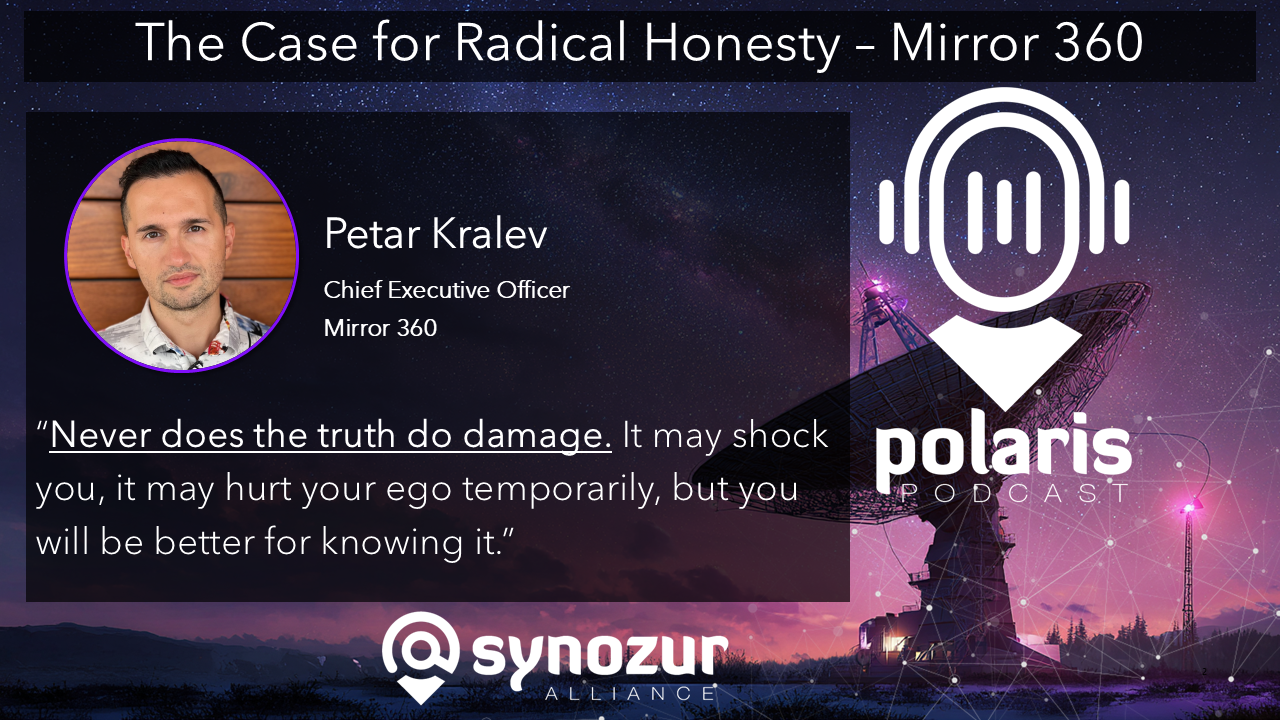
"Never does the truth do damage. It may shock you, it may hurt your ego temporarily, but you will be better for knowing it. And the world will be better for knowing it."
"It's the difference between turning on the lights or staying in the dark."
"What story do you tell yourself that you take for the truth? Because these stories really are the ceiling we impose on ourselves — and we forget that we just made them up."
References
Guest Notes
Mirror 360 — company website: mirror360.org.
Mirror 360 on LinkedIn: linkedin.com/company/mirror-360. P
Petar Kralev on LinkedIn: linkedin.com/in/petarkralev; Petar also publishes longer-form writing on the workplace visibility problem on Substack at https://substack.com/@petarkralev
Industry
Gallup, State of the Global Workplace: 2026 — global engagement at 20%, an estimated $10 trillion in lost productivity, and most of the recent decline attributed to falling manager engagement: gallup.com.
U.S. engagement figures (United States and Canada at 31%, the highest-ranked region) from the same Gallup report: Gallup global data summary.
Culture
Eckhart Tolle, A New Earth (the book Petar recommends; Tolle is also the author of The Power of Now): eckharttolle.com.
Startup World Cup — the global startup competition whose Grand Finale takes place in San Francisco in November 2026, which Mirror 360 is advancing to after a Bulgaria regional win: startupworldcup.io.
Events
TechCon 365 Chicago — June 15–19, McCormick Place, Chicago, IL
TechCon 365 Seattle — August 24–28
CollabDays New England — October 16, 2026
Production
Polaris is produced with help from Riverside.fm. Our theme song, “Alternative Dream” is provided courtesy of Adobe. Additional music and sound provided by IndieGuy Records. Graphic design by Josh Brantley.
Chapters
00:00 Introduction to Petar Kralev and Mirror 360
01:48 The decline in employee engagement and its implications
02:45 The personal journey of Petar and the origin of Mirror 360
04:52 The iceberg of ignorance and feedback challenges
07:28 Barriers to honest feedback and how Mirror 360 addresses them
10:18 Questions to ask for effective feedback
13:11 The role of AI in filtering and analyzing feedback
15:18 Ensuring anonymity and trust in feedback systems
17:44 The impact of honest feedback on organizational performance
19:59 The future of management and AI integration
22:02 Remote work challenges and digital water cooler moments
23:48 Success stories and organizational transformations
26:50 Petar’s personal story and authenticity in leadership
30:10 Book recommendation: A New Earth by Eckhart Tolle
31:31 How to stay connected with Petar and upcoming initiatives