You probably don't realize how much Larry Namer has shaped the entertainment you consume every day. If you've ever watched a red-carpet show, caught Jon Stewart's wit, followed the Kardashians, or simply flipped through celebrity news on any platform, you've experienced the ripple effects of what this media pioneer started decades ago.
On this episode of Polaris, we sit down with Larry Namer, co-founder of E! Entertainment Television, to explore his remarkable journey from working underground installing cables in Manhattan to building a multi-billion-dollar global media empire that transformed how the world engages with celebrity culture.
From Brooklyn to Broadcasting
Larry's story begins in Coney Island, Brooklyn—long before Disneyland, this was America's first major amusement center. Growing up in what he describes as a "lower, lower, lower, lower class neighborhood," Larry graduated with an economics degree and quickly discovered there weren't many jobs waiting for him.
So he took what he thought would be a temporary summer job: assistant underground splicer for a new thing called cable TV in Manhattan. The pay was $90 a week. That "temporary" job became the foundation of a five-decade career that would change global media forever.
The Wild West of Cable Television
In those early days, Larry found himself working for Sterling Manhattan Cable (later acquired by Time Inc.) under Chuck Dolan's leadership. "We were inventing it as we go along," Larry recalls. Having 17 channels felt miraculous when audiences were used to just ABC, NBC, and CBS.
But the real transformation came when Jerry Levin (yes, that Jerry Levin who would later lead Time Warner) proposed something radical: Home Box Office (HBO), with programming delivered via satellite. "What's a satellite?" was the genuine response from the team.
Larry watched as Ted Turner took an Atlanta station, put it on satellite, and distributed it nationally—creating TBS. Then came CNN, the first 24-hour news network. "Ted really led that whole, you know, everything can be 24 hours a day, seven days a week," Larry explains.
The lesson here for today's technology and business leaders? When the medium changes, everything changes. As Marshall McLuhan taught us, "the medium is the message." Cable didn't just add more channels—it fundamentally transformed what content could be and how audiences engaged with it.
Building E! Entertainment: The Power of Constraint
By 1980, Larry had risen from working in sewers to becoming director of operations in Manhattan at age 25, running the largest cable company in the US. He then moved to Los Angeles to build Valley Cable, the first 61-channel interactive cable system ever constructed.
But here's where the story gets interesting for entrepreneurs. Larry and his partner Alan Mruvka had an idea: create MTV for movies. Stand a host in front of a green screen, show movie trailers (which studios gave away for free), and surround premium content with low-cost production.
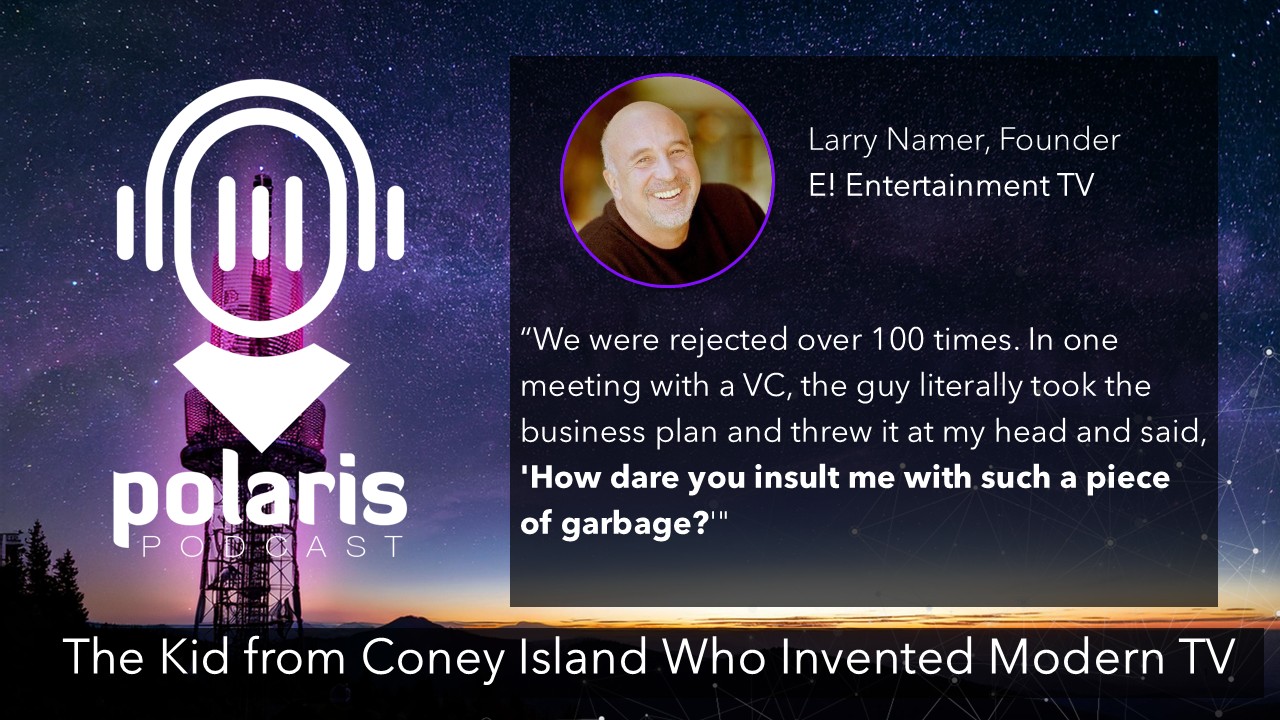
They needed between $60-100 million to launch—the typical cost for starting a TV network in that era. They were rejected over 100 times. In one particularly memorable meeting, a VC literally threw their business plan at Larry's head.
Finally, they met Jeff Pollack, an investment banker who loved the idea but could only authorize $2.5 million. After three and a half years of rejection, Larry and Alan took it.
They launched E! Entertainment Television with 11 employees, 31 interns from the University of Texas at Austin, and used training equipment from a company's sales department. "We didn't even have professional broadcast equipment," Larry admits.
That constraint became their competitive advantage. They couldn't dazzle with production value, so they got creative. They created Talk Soup, a show that made fun of other TV shows—a concept everyone said was crazy. But by making fun of other programs, they actually increased those shows' audiences, and everyone wanted to give E! their clips.
The show ran for 26 years.
Changing Red Carpet Forever
In their first year, E! applied for credentials to cover the Oscars and received a rejection with "a really nasty note," Larry recalls. So he and the crew climbed over the fence and snuck in.
On the red carpet, while Entertainment Tonight asked serious questions about upcoming movies, E! took a different approach: "Tom, those are amazing shoes. Where'd you get those?"
"We just took a whole different attitude," Larry explains. "Hollywood is funny stuff. Don't try and make believe it's rocket science."
That irreverent approach changed red carpet coverage forever and established E! as the first true influencer of global pop culture. Within the first year, they expanded to 14 countries—unheard of at the time.
Going Global: Russia, China, and Beyond
While most American media companies stayed US-centric, Larry saw technology bringing down barriers to entry worldwide. He worked with the mayor of St. Petersburg (and the vice mayor, a guy named Vladimir Putin) to create the White Nights Festival, raising money for children's hospitals and orphanages.
Putin later asked Larry to help rewrite Russia's media regulatory policy. Then China came calling, asking him to help transition their television from Communist Party TV to more commercial models.
Larry started Metan Global Media Group and became one of the leading providers of Western-style entertainment for Chinese-speaking audiences.
AI, Mastery, and What's Next
Today, Larry is focused on AI as the next transformative technology. He uses Perplexity AI extensively and credits it with helping his book "Offscript: Recipes for Success" hit the bestseller list in just four days.
"It used to take me five days to research and create a business plan. Now it takes me 30 seconds to do it with AI, but then it takes me an hour to edit it," he explains. "If I can get paid the same for my one hour work as I used to get paid for my five days of work, why would I not want to do that?"
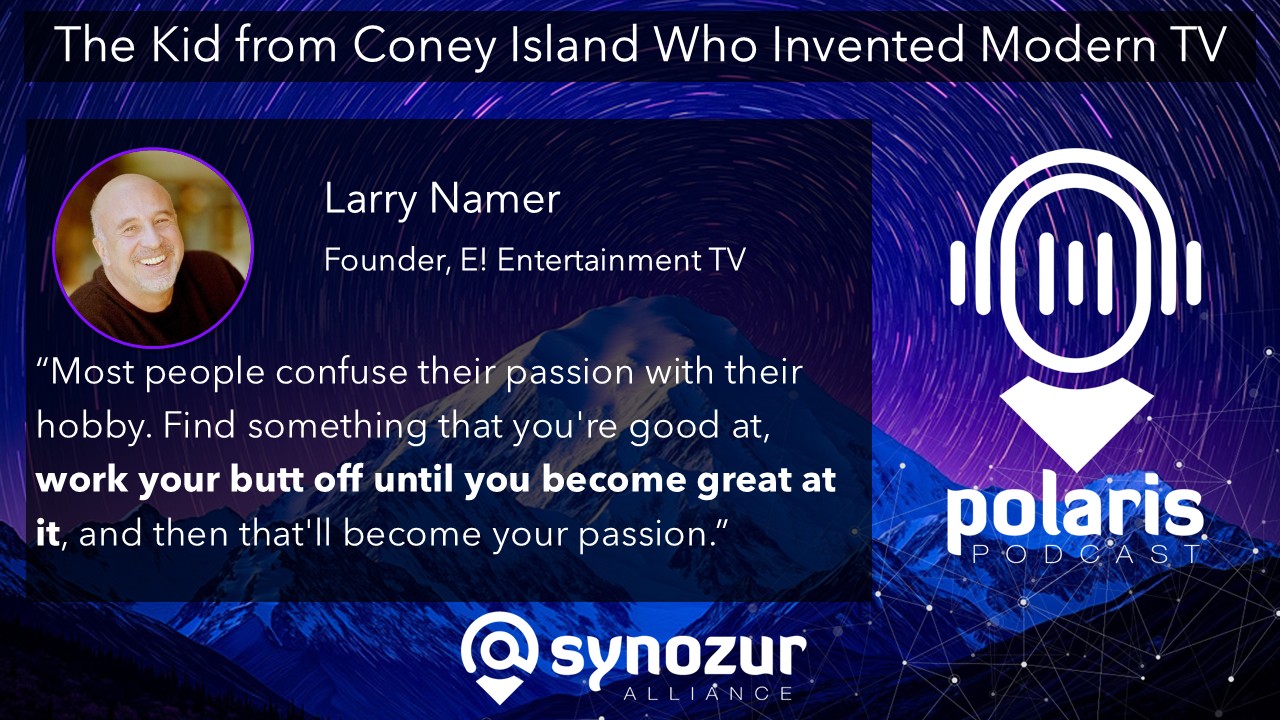
His advice to entrepreneurs challenges conventional wisdom: "Most people confuse their passion with their hobby. Find something that you're good at, work your butt off until you become great at it, and then that'll become your passion."
The Lesson for Leaders
According to Nielsen, streaming hit 38% of all TV usage by mid-2023, surpassing cable's 29% share for the first time. We're living through another McLuhan moment—the medium is changing again, and with it, everything about how we create and consume content.
Larry Namer has been at the forefront of these transformations for 50 years. From underground cables to satellite delivery to streaming and AI, he's consistently recognized when technology creates new opportunities and acted boldly despite rejection and constraint.
His upcoming projects include The Immigrant Podcast celebrating immigrant experiences in America, and Stall Talk, a women's empowerment show—plus continued series development for Netflix and Amazon.
For business and technology leaders navigating their own transformations, Larry's journey offers clear lessons: embrace new technology early, think globally from day one, turn constraints into competitive advantages, and remember that time is your most valuable asset.
And maybe, just occasionally, you need to climb over a fence to get where you're going.
Listen to the full episode at https://polaris.synozur.com.
Polaris is available on Apple, Spotify, Amazon, YouTube or wherever you get your favorite podcasts. Thanks.
Show Notes
Takeaways
Technology Creates Opportunities for the Bold: Larry started E! with just $2.5 million and 31 interns when competitors needed $60-100 million, proving that constraints can drive innovation and focus when you understand the technology landscape.
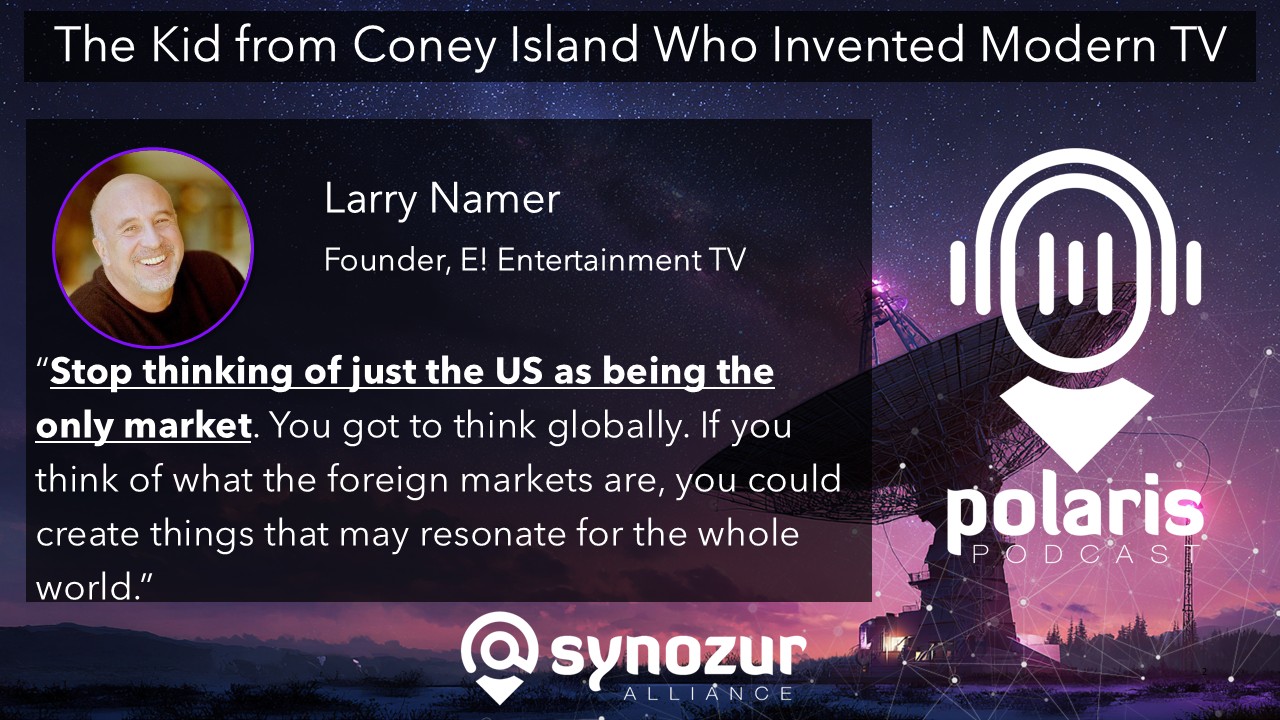
Think Globally from Day One: E! expanded to 14 countries in its first year by recognizing that the world loves Hollywood content—a lesson that applies to any business in today's interconnected marketplace.
Embrace AI as a Creative Amplifier, Not a Replacement: Larry uses AI tools like Perplexity to reduce business plan creation from five days to one hour of editing, freeing time for higher-value creative work and strategic thinking.
The Medium Shapes the Message: From broadcast to cable to streaming, each technological shift doesn't just change distribution—it fundamentally transforms what content can be and how audiences engage with it.
Follow Competence, Not Just Passion: Larry's advice challenges conventional wisdom: most people confuse passion with hobbies. Instead, find something you're good at, work until you're great, and that mastery will become your passion while funding your hobbies.
Know When to Pivot: Assess your projects regularly. Time is your most valuable asset, and successful entrepreneurs recognize when market conditions, technology, or regulations have changed enough to warrant a new direction.
Low-Cost Innovation Beats High-Budget Imitation: E! succeeded by getting premium content (movie trailers, celebrity footage) for free and surrounding it with low-cost production, following MTV's model but applied to entertainment instead of music.
Sound bites - Larry Namer
On Entrepreneurship and Rejection:
"We were rejected over 100 times. In one meeting with a VC, the guy literally took the business plan and threw it at my head and said, 'How dare you insult me with such a piece of garbage?'"
On AI and the Future:
"Anybody who's not learning AI and how to bring AI into their equation is going to get left behind. It's an unbelievable creative tool. It used to take me five days to research and create a business plan. Now it takes me 30 seconds with AI, then an hour to edit it."
On Global Thinking:
"Stop thinking of just the US as being the only market. You got to think globally. If you think of what the foreign markets are, you could create things that may resonate for the whole world."
On Passion vs. Mastery:
"Most people confuse their passion with their hobby. Find something that you're good at, work your butt off until you become great at it, and then that'll become your passion, which will then give you enough financial resources to enjoy your hobbies."
References
Larry Namer's Company & Social Media
LJN Media (Larry Namer's company): https://www.ljnmedia.com
Larry Namer on LinkedIn: https://www.linkedin.com/in/larry-namer
Larry Namer on IMDb: Larry Namer - IMDb
Larry Namer on Wikipedia: Larry Namer - Wikipedia
Larry Namer's Book
"Offscript: Recipes for Success" by Larry J. Namer: https://www.amazon.com/Offscript-Recipes-Success-Larry-Namer/dp/B0DVNY8KH6 [Amazon]
Larry Namer's Upcoming Projects
The Immigrant Podcast (launching on YouTube and Spotify) Pamela Anchang, Will Launch A Lifestyle Show with Heart, “The Immigrant Podcast” in January with Larry Namer, Founder of E! Entertainment - Formidable Woman US
Stall Talk (women's empowerment podcast) Stall Talk Podcast (@stalltalkbabes) • Instagram photos and videos
Companies & Networks Mentioned
E! Entertainment Television:
HBO (Home Box Office):
CNN:
TBS (Turner Broadcasting System):
MTV (Music Television):
Netflix:
YouTube:
TikTok:
Spotify:
Fox Broadcasting:
Cultural References & Locations
Coney Island, Brooklyn, New York: Visitor Information | Coney Island Fun Guide | New York
Nathan's Famous Hot Dogs: Nathan’s Famous Hot Dogs & Restaurants | Nathan’s Famous
Star Trek: The Next Generation Syndication | Memory Alpha | Fandom
The Kardashians: https://en.wikipedia.org/wiki/The_Kardashians
Personalities & Shows Mentioned
Jon Stewart (The Daily Show, Talk Soup alumnus) Jon Stewart - Wikipedia
Jimmy Kimmel (Jimmy Kimmel Live!)
Greg Kinnear (Talk Soup host)
Craig Kilborn (Talk Soup host)
Howard Stern (The Howard Stern Show)
Tom Cruise (actor)
Arnold Schwarzenegger (actor)
Madonna (musician)
Muhammad Ali (boxer)
Joe Frazier (boxer)
George Foreman (boxer)
Tom Brady (NFL quarterback)
Media Executives & Visionaries Mentioned
Chuck Dolan (founder of Cablevision, HBO)
Jerry Levin (former CEO of Time Warner, architect of HBO)
Ted Turner (founder of CNN, TBS)
Barry Diller (media executive)
Alan Mruvka (E! co-founder with Larry Namer) Alan Mruvka - Wikipedia
Vladimir Putin (former Vice Mayor of St. Petersburg, current Russian President)
Rupert Murdoch (founder of Fox)
Concepts & Statistics Referenced
Marshall McLuhan's "The medium is the message" concept The medium is the message - Wikipedia
Streaming viewership statistics: via Nielsen's The Gauge report Streaming Reaches Historic TV Milestone, Eclipses Combined Broadcast and Cable Viewing For First Time | Nielsen [May 2025]
Malcolm Gladwell's 10,000-hour rule for mastery Outliers (book) - Wikipedia
Historical References
Bruce Springsteen's "57 Channels (And Nothin' On)": 57 Channels (And Nothin' On) - Wikipedia
The Beatles' White Album The Beatles (album) - Wikipedia
The Onion (satirical news): www.theonion.com
International Locations Discussed
St. Petersburg, Russia (White Nights Festival, June 16-21 annually)
Moscow, Russia
Beijing, China
Shanghai, China
Croatia (Larry's favorite international destination)
Events
Strategy - Now With AI | January 6, 2026 (Onlin
M365 Community Days DC 2026 January 29-30 at Microsoft Innovation Hub in Arlington VA
Partner Vibe | January 28-30 at the Marriott Courtyard in South Padre Island Texas
M365 Community Conference | April 21-23 at the Loews Saphire Falls in Orlando Florida
AI+IM Summit | April 28-30 Hyatt Regency Inner Harbor, Baltimore, MD
Production
Polaris is produced with help from Riverside.fm. Our theme song, “Alternative Dream” is provided courtesy of Adobe. Additional music and sound provided by IndieGuy Records. Graphic design by Josh Brantley.
Chapters
00:00 Introduction
01:44 Terms and Data Points
05:06 The Wild West of Early Cable Television
07:31 The Birth of Home Box Office and Content Creation
10:16 Innovating in Cable: The Rise of E! Entertainment
13:18 The Challenges of Starting a New Network
16:17 The Impact of E! Entertainment on Pop Culture
18:53 Redefining Entertainment: The Talk Soup Phenomenon
21:36 Reflections on Success and Global Influence
24:23 International Expansion and Media Ventures
29:55 The Evolution of Technology in Media
34:00 AI's Impact on Creativity and Business
39:16 Cultural Reflections and Personal Passions
41:27 Upcoming Events and AI Strategy for 2026
43:06 The Beatles and Bruce Springsteen
44:26 Next on Polaris
45:00 Guest Insights on Technology and Business Innovation