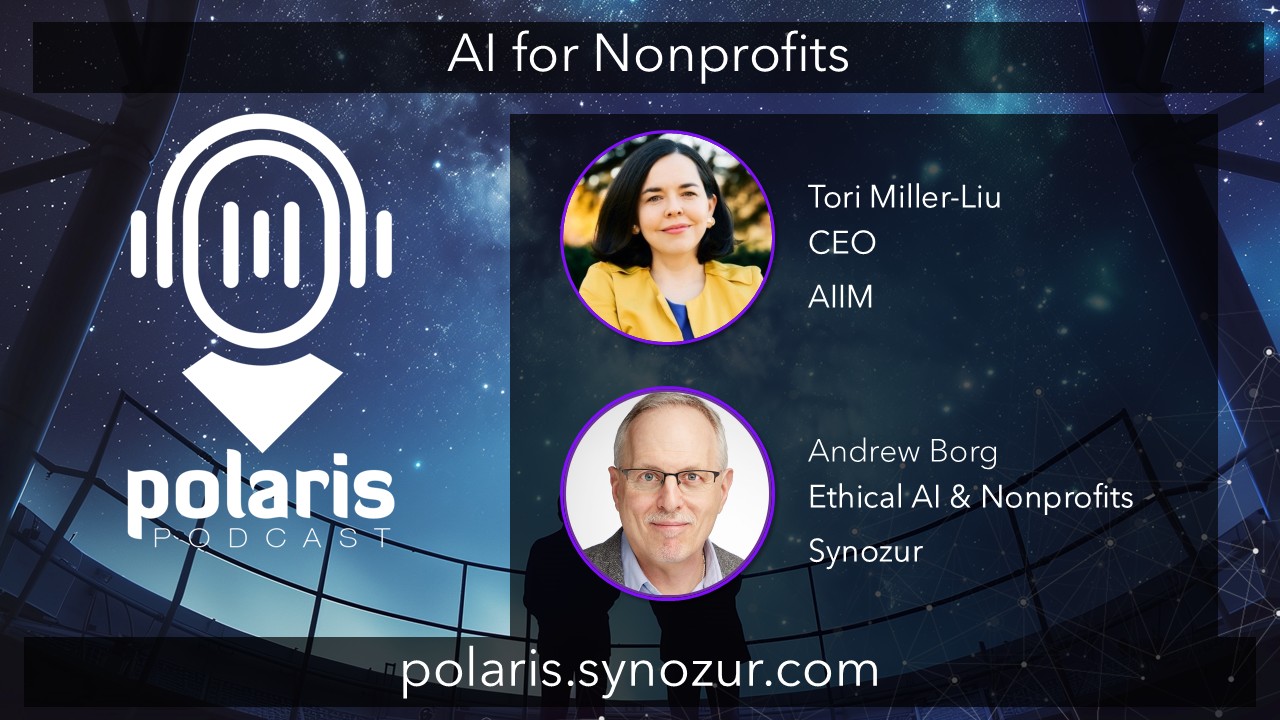
You don’t need a lab to see the opportunity. If you lead a nonprofit or association, you can use AI right now to relieve operational strain and improve outcomes—without losing the human touch your stakeholders depend on. On our latest Polaris episode, I sat down with Tori Miller‑Liu (AIIM) and Andrew Borg (Synozur) to unpack what’s working, what isn’t, and how to move forward responsibly.
The pattern they're seeing
Start with where AI already fits: search, summarization, finance workflows, and research assistance. Think of AI as a force multiplier for small teams. Tori described how associations are using assistants to route requests faster and surface institutional knowledge, while keeping humans front‑and‑center for member belonging and governance. Andrew underscored a key constraint: privacy and access control aren’t optional—especially in sensitive contexts.
Governance is the gap—and the opportunity
Sector surveys show widespread AI experimentation alongside a policy deficit. That’s fixable. Create a one‑page AI use policy (what’s in/out, data handling, disclosure), attach a pilot charter (problem, measures, model of record), and review quarterly. Leaders should also track regulatory milestones: the EU AI Act has a staggered timeline—prohibitions (Feb 2025), GPAI obligations (Aug 2025), and most high‑risk provisions (Aug 2026). If your cloud or vendors operate in the EU, you’ll inherit some obligations.
A pragmatic roadmap: from assistant to agent
Microsoft’s 2025 Work Trend Index names the next operating model: human–agent teams. In nonprofits, that can look like: an AI triaging inquiries; a rules‑based agent filling forms from verified data; and a human caseworker resolving exceptions and building trust. Start small, measure outcomes, then scale to adjacent use cases.
Where to begin (without boiling the ocean)
Inventory your platforms and switch on the AI features you already pay for (search assistants, content classifiers, form extraction).
Pilot a member‑facing workflow with clear escalation to humans—e.g., “conversational search” that cites its sources and offers a “ask a human” handoff. (IBM’s watsonx Assistant is one example of this pattern.)
Stand up a lightweight AI Center of Practice: a program lead, a data/logistics owner, and a business sponsor accountable for outcomes.
Don’t confuse scale with success
It’s tempting to “automate everything,” but the better lens is “augment what matters.” Coverage of a 2025 MIT study on enterprise AI found most pilots fail to show ROI because they’re not tied to real workflows or require too much verification. Nonprofits can avoid that trap by anchoring on mission outcomes (response time, case cycle time, donor retention) and by keeping humans in the loop where reputation and equity are at stake.
Ethics, equity, and the long game
Andrew put it plainly: today’s models don’t have a moral core. That means your ethics—privacy by design, bias testing, and transparent disclosures—are the differentiator. Sector coalitions like NetHope make this easier by sharing tools and governance templates built for nonprofit realities.
The bottom lineYou can get real value from AI this quarter—without risking trust—by pairing tight governance with focused pilots that free your people to do more of the work only they can do. That’s how AI becomes a force for good in your mission.
Polaris is available on Apple, Spotify, Amazon, YouTube or wherever you get your favorite podcasts. Thanks.
Show Notes
Polaris is a production of Synozur – the transformation company. Synozur reimagines business for our clients, navigating the complexities of transformation and strategy with ease.
Takeaways
AI is a force multiplier, not a headcount reducer. The biggest value today is in accelerating research, finance, content triage, and enterprise search—so your people spend more time on strategy and relationships.
Governance is behind adoption. Surveys show most nonprofits use AI in some form, but comparatively few have formal policies—an exposure area leaders should close.
Regulation is real—and staggered. The EU AI Act is now law (entered into force Aug 1, 2024) with phased obligations through 2026; even non‑EU orgs will feel its ripple effects via vendors and data flows.
“Frontier Firm” playbook is emerging. Microsoft’s 2025 Work Trend Index highlights human–agent teams and “intelligence on tap”; nonprofits can apply the same operating model to scale impact responsibly.
Ethics + belonging are differentiators. Keep human connection in the loop—AI can process, route, and answer, but it shouldn’t replace the sense of community members join for.
Start with existing platforms. Many nonprofit tech vendors now ship AI capabilities; piloting within your current stack reduces cost, risk, and time to value.
Data privacy & access control are non‑negotiable. Especially for nonprofits working in sensitive contexts—design for minimum necessary data and tight permissions from day one.
Sound bites
Tori Miller‑Liu
“Use AI to multiply value—not replace people. Our job is advancing member outcomes, and AI helps us do more of that.”
“Belonging beats the bot. Let AI handle transactions; keep humans where community and trust are built.”
“Start where you are: pilot inside the tools you already own before building from scratch.”
Andrew Borg
“For nonprofits, AI is a force multiplier on training wheels—powerful, but it still needs guardrails.”
“Keep AI at arm’s length ethically. Until models have a moral core, humans must stay accountable.”
“Cooperate to accelerate. Sector coalitions let nonprofits share tools, data, and hard‑won lessons.”
“Don’t buy the hype—buy outcomes. The winners align AI to real missions and measurable value.”
References
Guest Notes
Tori Miller‑Liu (LinkedIn): CEO of AIIM (Association for Intelligent Information Management)
Andrew Borg (LinkedIn):Head of Ethical AI & Nonprofits at Synozur
Industry Notes
82% of nonprofits are using AI; Nonprofit Quarterly: “Sector Adopting AI, Building Reserves, and Expanding Missions
European Commission: “AI Act enters into force” (Aug 1, 2024)
Fast Forward’s accelerator program saw six times more AI-powered nonprofit applicants than the year before: Stanford Social Innovation Review: “Mapping the Landscape of AI‑Powered Nonprofits”
300% increase since 2018 in the use of AI to address the UN Sustainable Development Goals (Google.org (Research brief))
IBM watsonx Assistant (conversational search / RAG)
ASAE: Association Coalition for AI (ACAI)
Forbes Coverage of MIT “GenAI Divide” ROI findings (context for ‘95% fail’ headline)
Jared Spataro from Microsoft on defining the “frontier firm” and on ‘headline hype’ obscuring the real buseinss value of AI.
NetHope “AI Lighthouse” for Nonprofits (responsible AI resources)
Culture Notes
Avett Brothers and “Swept Away” on Broadway (official)
Events
Experts Live | October 10, 2025 at Microsoft NYC in Times Square
CollabDays New England 2025 | October 17, 2025 Microsoft New England in Burlington MA
Vancouver AI Summit | October 20, 2025 Vancouver BC
TechCon 365 Dallas - | November 3-7, 2025 (Dallas, TX). Irving Convention Center
Microsoft Ignite 2025 – Nov 17-21, 2025 (San Francisco, CA).
ESPC25 (European SharePoint Conference 2025) | Dec 1-4, 2025 (Convention Centre Dublin (CCD) Dublin, Ireland).
Production
Polaris is produced with help from Riverside.fm. Our theme song, “Alternative Dream” is provided courtesy of Adobe. Additional music and sound provided by IndieGuy Records. Graphic design by Josh Brantley.
Chapters
00:00 Introduction to AI and Its Impact
01:51 News and Data Points
03:42 Tori Miller-Liu and Andrew Borg
06:10 AI in Nonprofits: Opportunities and Challenges
08:04 The Dichotomy of AI Perception
10:50 Governance and Risk in Nonprofits
13:44 AI as a Force Multiplier
16:03 The Future Workforce and AI
16:38 The Role of Education in AI Utilization
19:52 Human-AI Interaction and Ethical Considerations
21:53 AI's Role in Enhancing Community Engagement
24:30 Cooperation Among Nonprofits
27:24 Advice for Nonprofits on AI Adoption
33:43 Cultural Reflections and Personal Insights
37:36 Upcoming Tech Events Overview
38:29 Closing and Acknowledgments